
Get the picture thereover any link, in any format.
Bilbycast unifies SRT, RIST, RTMP, HLS, WebRTC, and SMPTE ST 2110 under one AI-assisted control plane — with in-process transcoding and driver-aware control that extends to third-party broadcast devices. The transcode box, the NMOS gateway, the protocol bridge, and the dashboard for it all — collapsed into one Rust suite.
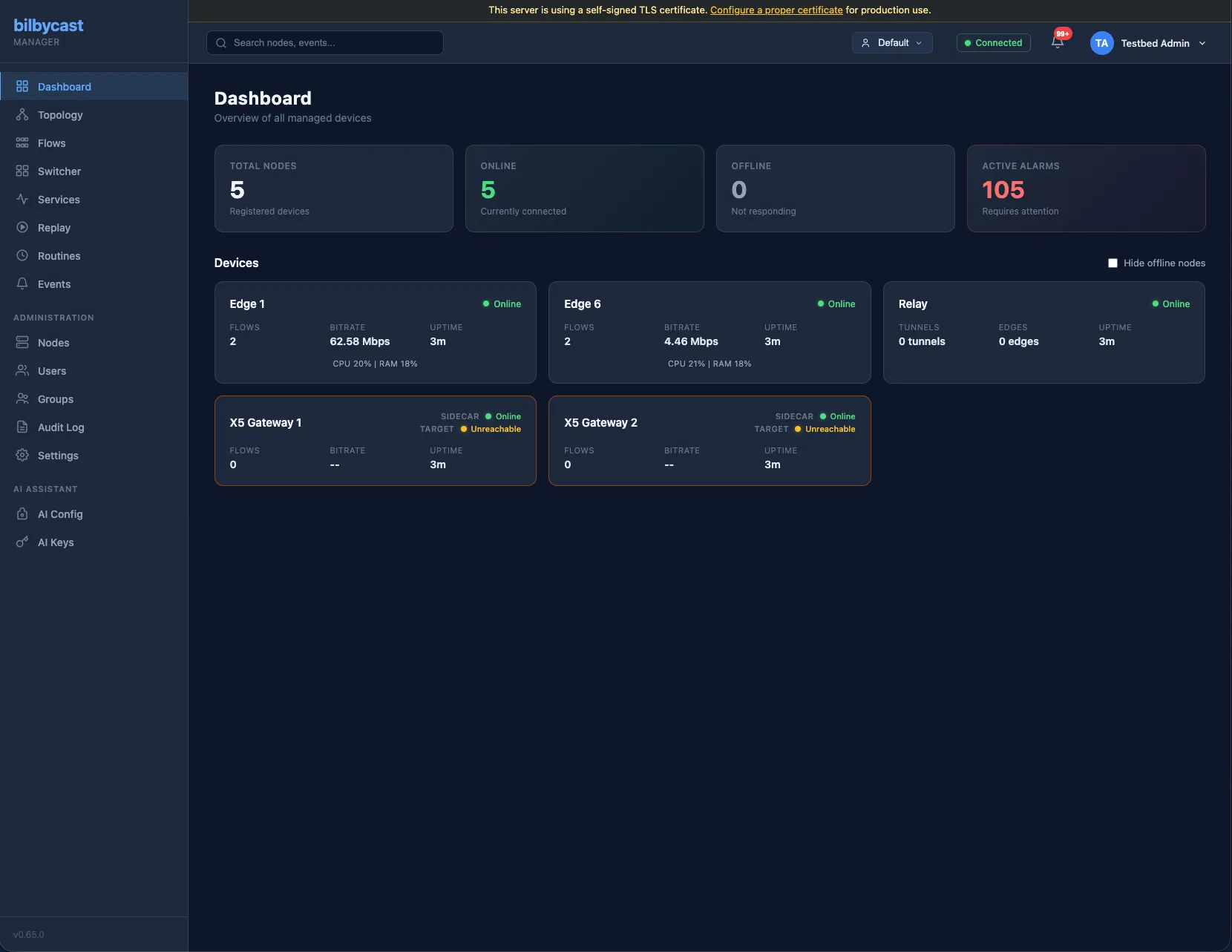
Replaces a rack of single-purpose appliances.
Most live-media plants are still a stack of boxes — one for transcoding, one for the NMOS bridge, one for SRT, one wall processor for the multiviewer, and a different vendor dashboard for each. Bilbycast collapses them into a single Rust suite that runs on commodity off-the-shelf hardware — 1U server, ARM appliance, or virtual machine.
Pure-Rust gateway. Bonding, transcoding, every protocol, NMOS, hitless redundancy, multiviewer walls, replay, encryption — all in process.
Four things Bilbycast does that nobody else puts in one box.
Pick the pillar that matches your job. Each links through to a deeper page with diagrams and screenshots.
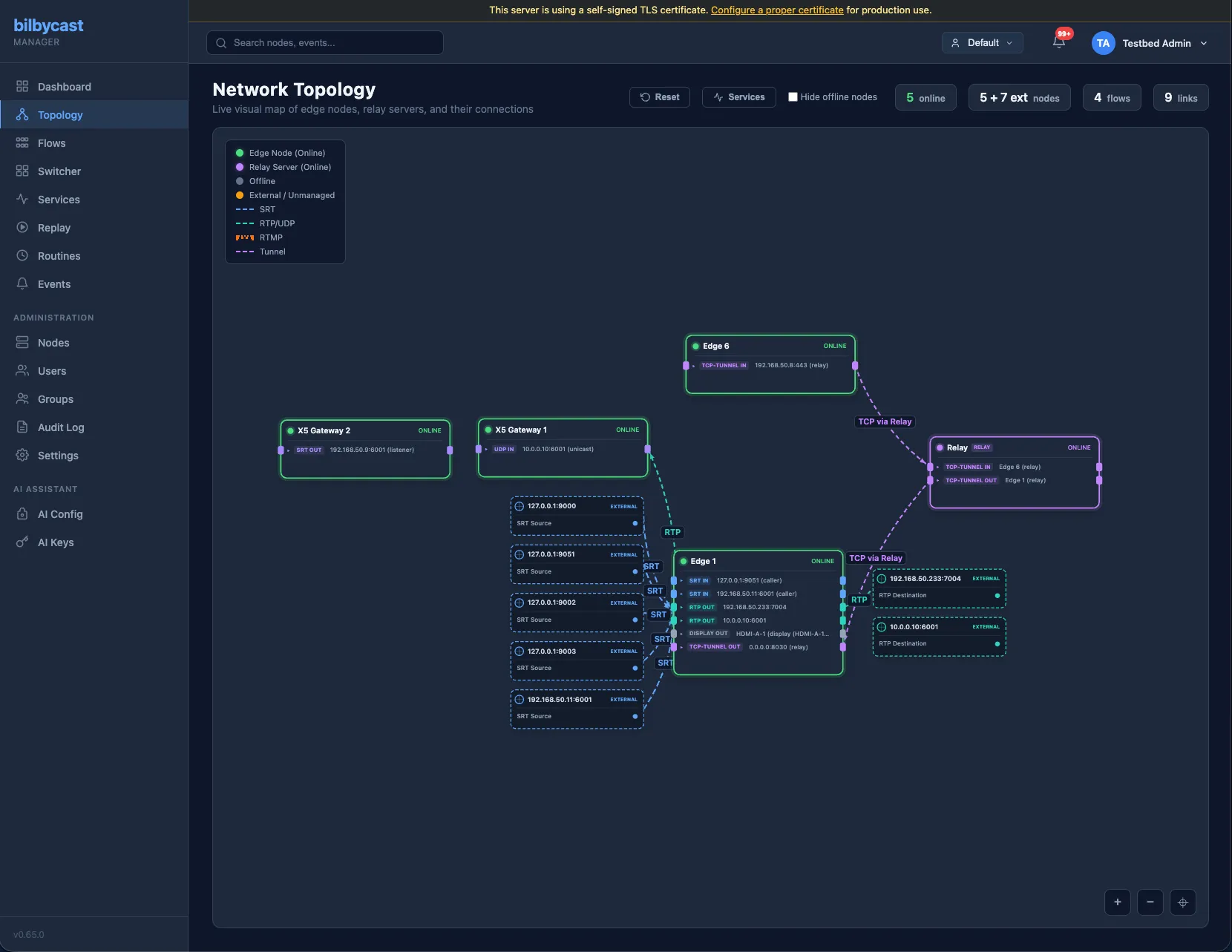
Manage your whole media plant from one screen.
Real-time topology, per-flow stats, live thumbnails, AI-assisted flow creation, driver-aware control of third-party broadcast devices. Multi-tenant Groups with brand theming, OIDC SSO, MFA, encrypted backup, envelope-encrypted secrets at rest.
- AI flow assistant — OpenAI, Anthropic, or Gemini, credentials stripped before context
- Driver-aware action system — Bilbycast and Appear X today, vendor SDK published
- Multi-tenant Groups with brand theming, OIDC SSO, MFA, encrypted backup
- Visual Flow Editor — draw a unit on a canvas, or a whole multi-node path on one master graph
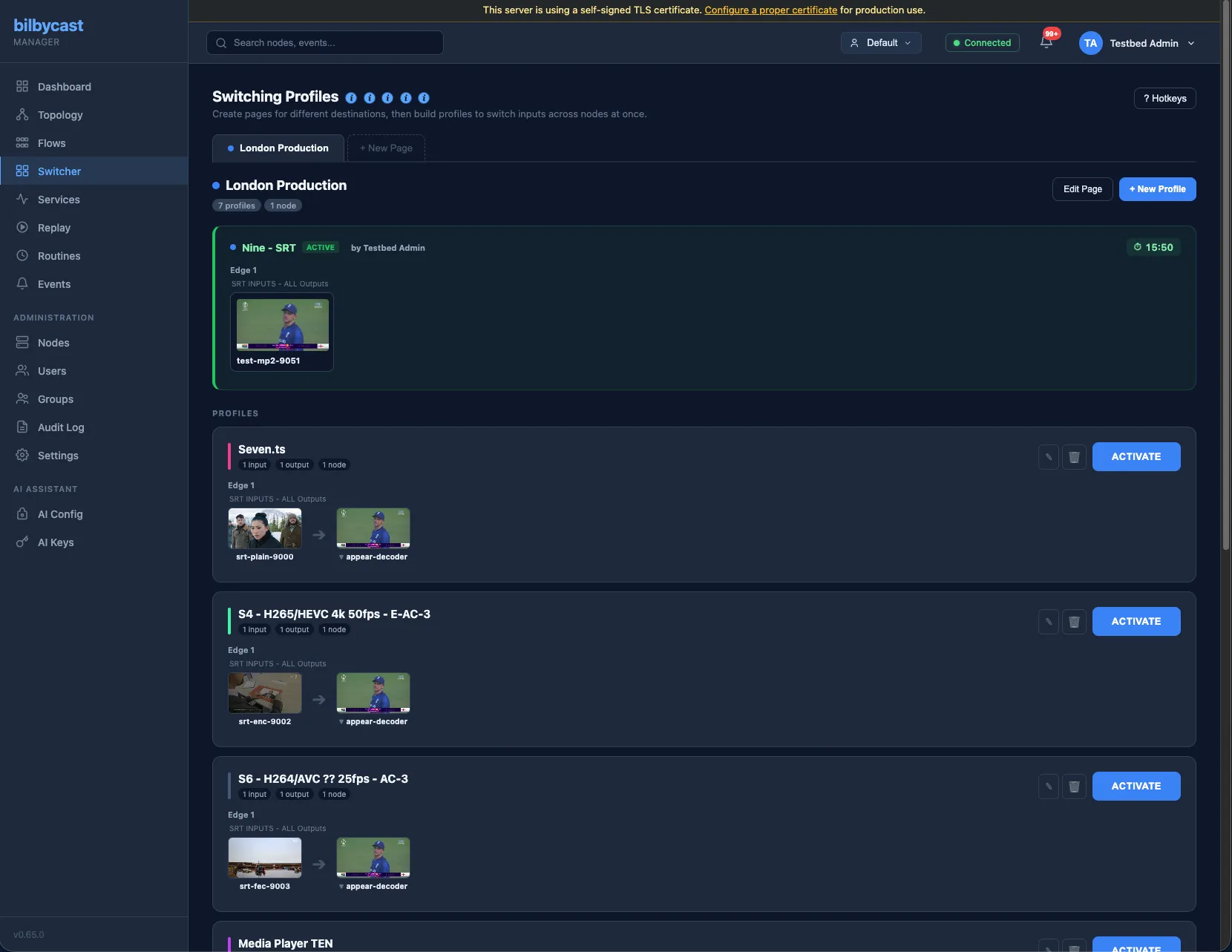
One gateway, every format.
Twelve protocols in a single Rust binary — ingressed and egressed, with HLS and CMAF-LL delivered on egress only and RTSP pulled on ingress only. In-process video transcoding (H.264 / HEVC / NVENC) and audio transcoding (AAC / Opus / MP2 / AC-3) — no ffmpeg subprocess, no separate transcode box. NMOS-friendly out of the box.
- SRT (+ multi-path bonding), RIST, RTP, RTMP, HLS, CMAF-LL, WebRTC, ST 2110-20/-23/-30/-31/-40, MXL, and SDI (Blackmagic DeckLink) capture + playout
- Node Bus Matrix — one edge as a node-wide ES distribution matrix; PES-aligned splice keeps receivers locked
- In-process transcode for both video and audio, end-to-end encrypted on the wire
- Multiviewer walls composited on the edge and published as an ordinary flow — no separate mosaic processor
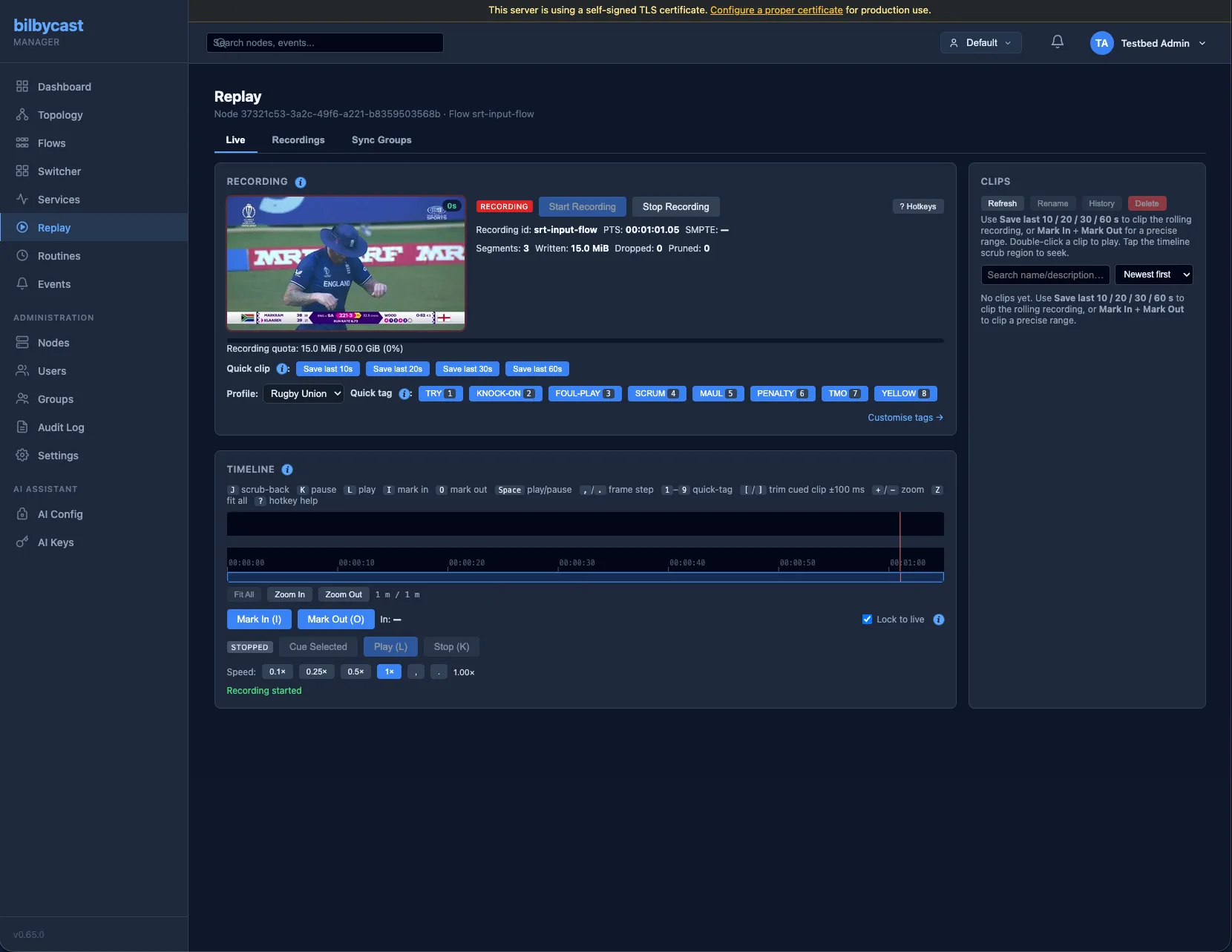
Built for live sports.
JKL-scrub Replay with mark in/out, customisable per-sport tag profiles, push-to-air per clip, and a PGM/PVW Switcher for the director. Cron-scheduled Routines automate the show-day workflow with DST-correct timezones.
- Per-flow Replay with lock-to-live and ± 100 ms bracket-trim
- Sport-preset catalog: Soccer, Rugby, NFL, AFL, Cricket, Tennis, Hockey, Basketball, Volleyball, Baseball, and more
- Live Switcher (PGM/PVW), PES-aligned multi-cam splice on a single output PID, Routines (cron + AI)
Drops into your broadcast facility.
NMOS IS-04 / IS-05 / IS-08 discovery, connection management, and audio channel mapping. Full SMPTE ST 2110-20 / -23 / -30 / -31 / -40 with PTP, 2022-7 Red/Blue, and BCP-004 receiver capability sets. Speaks the standards your control system already speaks.
- NMOS IS-04 / 05 / 08 + BCP-004 — registered, controlled, and audio-mapped natively
- SMPTE ST 2110-20 / -23 / -30 / -31 / -40 + PTP + 2022-7 Red/Blue
- SMPTE 2022-1 FEC, TR-101290 transport-stream analysis, RIST TR-06-1 / TR-07
See it in action
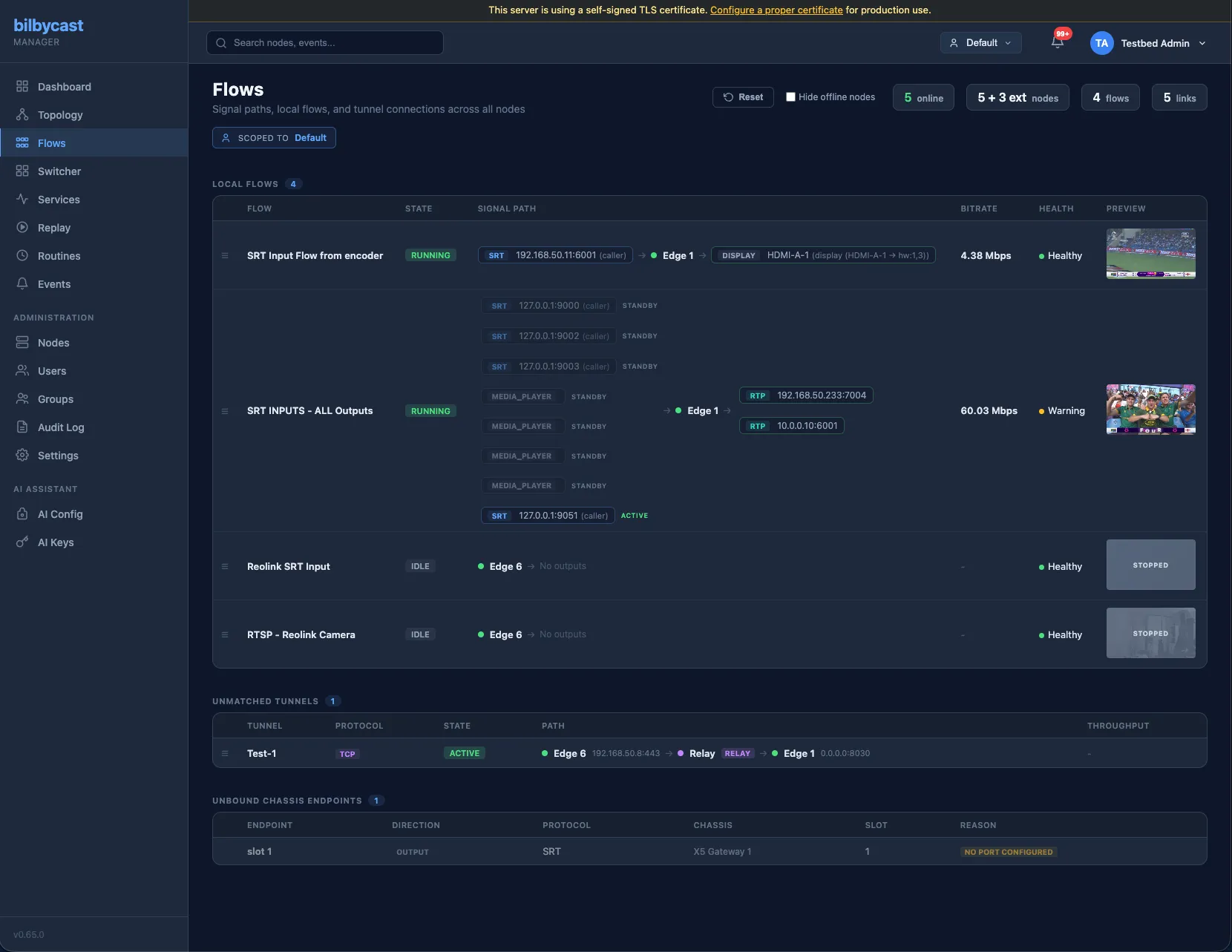
A management interface built for live broadcast operators, not for cloud admins.
Flows Overview
Monitor every media flow across nodes — live thumbnails, bitrate, protocol badges, health status.
Network Topology
Live visual map of edge nodes, relay servers, and connections with protocol-aware routing.
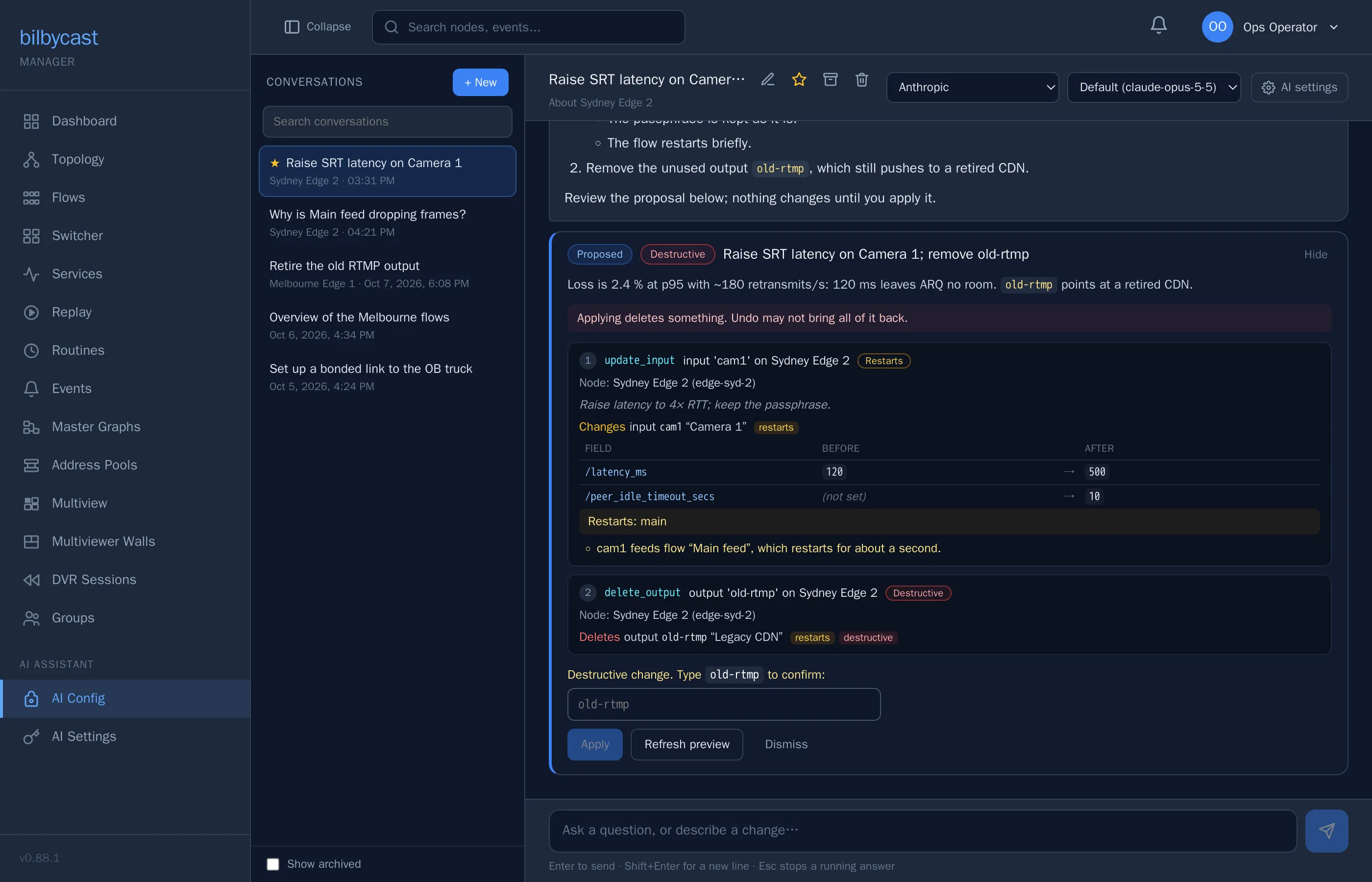
AI Assistant
Ask about the fleet or describe a change: the assistant proposes it as a field-by-field preview, and nothing changes until you apply it. Anthropic, OpenAI, Gemini, or your own model.
Who it's for
Two flagship audiences, two follow-ons. Pick the one that matches your day.
Broadcast facility & integrators
You bridge SDI / SMPTE 2110 with internet protocols inside an NMOS plant — and need one screen to drive it.
- NMOS IS-04 / 05 / 08 + BCP-004; SMPTE ST 2110-20/-23/-30/-31/-40 + MXL + SDI + PTP + 2022-7
- AI-assisted flow creation, real-time topology, multi-tenant Groups
- Driver-aware control of Bilbycast and third-party broadcast devices
OTT & live distribution
You need to land contribution feeds and fan them out to viewers in every format.
- Ingest SRT / RIST / RTMP / WebRTC, fan out to HLS / CMAF-LL / WebRTC
- In-process H.264 / HEVC / NVENC video and AAC / Opus / MP2 / AC-3 audio
- Hot input switching with zero-gap PMT bump — no glitch on failover
Set it up in 10 minutes.
Runs on commodity off-the-shelf hardware. Edge and relay are free under AGPL 3; manager is free for up to 10 nodes. No sign-up wall, no credit card. The same binaries you'd run in production.