
Manage your media plantlike software, not appliances.
One control plane for Bilbycast and third-party broadcast devices. AI-assisted flow creation, real-time topology, multi-tenant Groups with brand theming. Free for up to 10 nodes.
Capabilities
Seven things the manager does that vendor-specific dashboards don't.
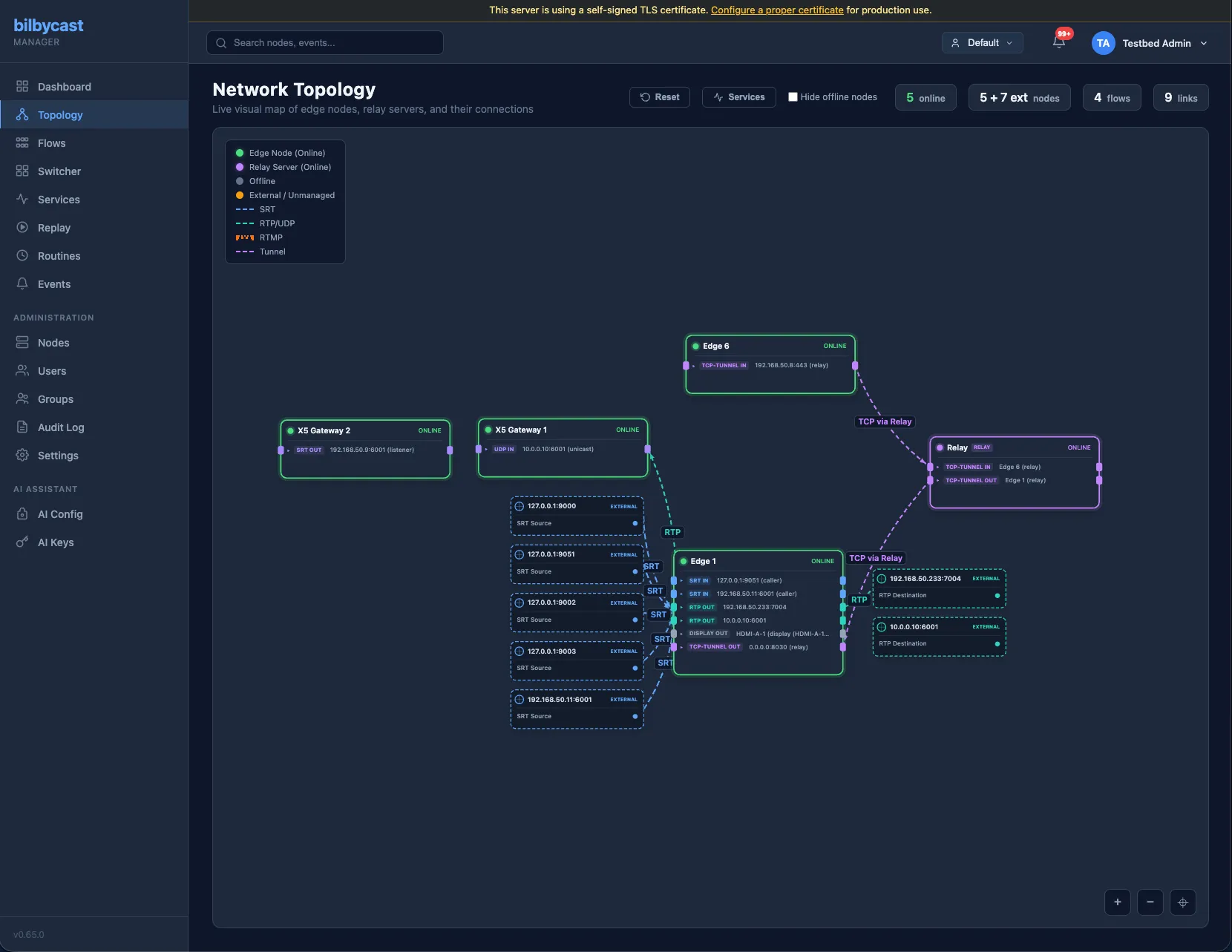
Real-time topology
Live visual map of every edge, relay, and third-party device. Connections light up as data flows. Click any node for a deep-dive: live video preview, TR-101290 transport analysis, codec detection, fan-out topology.
Visual Flow Editor — draw the config
Lay a unit out on a canvas — inputs, outputs, flows — and wire it by hand. Master graphs put several units on one canvas with the cross-unit transport drawn between them, so a multi-node contribution path is one picture instead of one form per box. Drafts are durable, validated before anything is pushed, previewed without side effects, and deployed per unit with a history you can restore from. Listen addresses can come from an address pool you declare installation-wide, per group, or per network zone. On by default on every install — access is per node and per role, not per licence.
AI assistant that proposes, never acts
A built-in AI assistant reads your fleet — configuration, live statistics, events, history — to answer questions and investigate faults. Changes come back as proposals: a field-by-field preview with risk, validation and permission checks, applied only when you press Apply. Anthropic, OpenAI, Gemini, or a model on your own network; secrets are redacted before anything reaches a provider.
Driver-aware control of third-party devices
A plugin architecture treats every device type — Bilbycast edge, relay, and third-party broadcast hardware — as a self-contained driver. Today: Bilbycast and Appear X. Tomorrow: whatever you build with the Gateway SDK.
Multi-tenant Groups with brand theming
Tenant-isolated users, resources, and quotas with per-tenant logo and brand-colour theming. White-label out of the box. Cross-tenant tunnels, share-cron, ownership transfer, per-tenant Switcher pages.
Routines — automate show-day workflows
Cron-scheduled named target states across flows. DST-correct via IANA timezones. Real-time fire-partial / fire-failed / missed events. One routine can cue 50 flows simultaneously.
Per-node "Open Device Web UI" link
Operators add a URL on the node row that opens the device's own admin UI in a new tab. The manager is not in the request path — point the URL at whatever port-forward, SSH tunnel, or LAN address reaches the device from your browser.
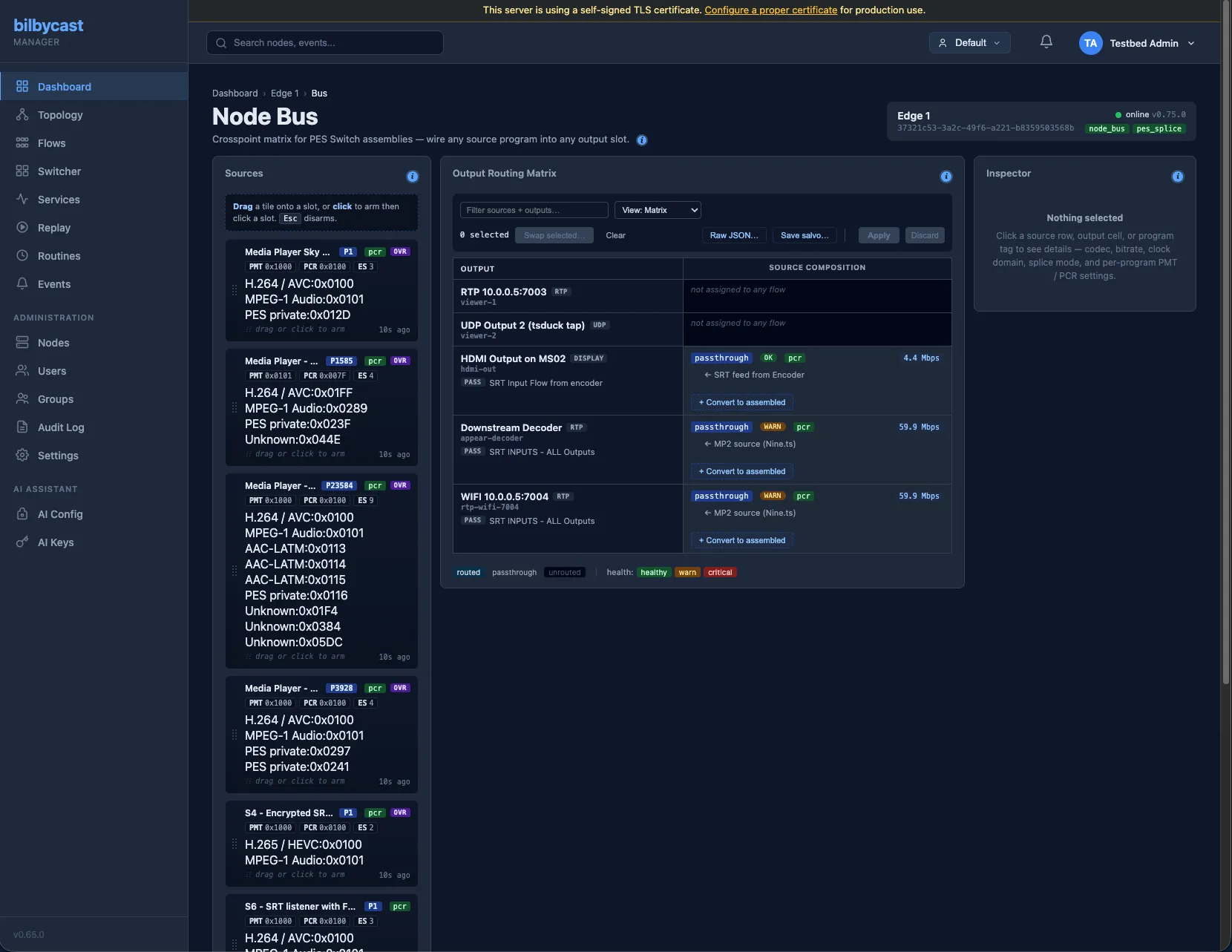
Crosspoint authoring for the node-wide ES bus.
A Lawo-style routing matrix that turns one edge into a full distribution surface. Sources pane lists every input program; the crosspoint matrix runs along every output's assembled programs; the inspector lets you fine-tune slot splice modes and lipsync trim. Click-to-wire and drag-and-drop are equally first-class. Pending changes are highlighted in Lawo orange; Apply (N) commits every route atomically per flow.
- Master-clock identity preflight — refuses cross-PTP / cross-PCR-PLL routes before the WS round-trip
- Per-slot
splice_modedropdown —pmt_bumporpes_alignedfor receiver-friendly switching - Save salvo — capture the current routing as a Switcher preset for one-click recall on show day
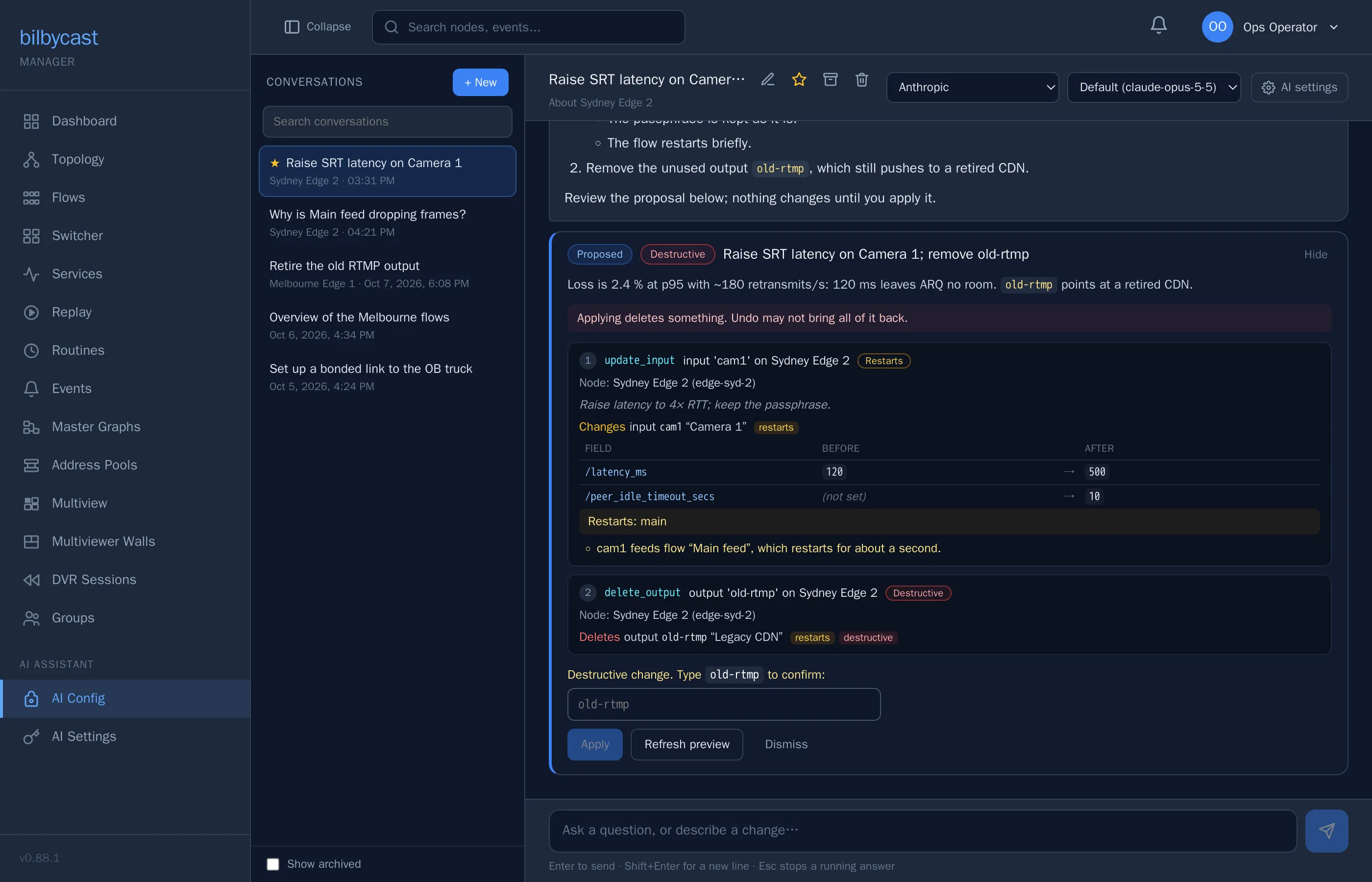
"Camera 1 keeps dropping out — raise its SRT latency, and get rid of that old RTMP output."
Ask in plain English. The assistant reads the live state, explains what it found, and proposes the change: every step previewed against the running configuration, field by field, with what restarts, what goes on air and what is deleted. Nothing changes until you apply it — and anything on air or destructive asks you to type a confirmation first. Each step then runs through the same API, permissions and audit trail as a click in the UI, and Undo turns an applied proposal into a new one that reverses it.
- Reads topology, configuration, live statistics, events and history — as you, with your permissions
- Proposes, never executes — you review the preview and apply it
- Secrets redacted before anything reaches a provider; new ones generated by the manager at apply time
Your key, your organisation's, or your own model.
Anthropic, OpenAI and Gemini, or any OpenAI-compatible endpoint you host. Users can bring their own keys; a Super Admin sets organisation keys and a policy deciding which providers may be used and whether personal keys are allowed. Keys are checked with the provider when saved, envelope-encrypted at rest under the ai-key KEK domain, and never appear in audit entries or API responses.
Security baseline
No bolt-ons. Every install ships with the same security primitives.
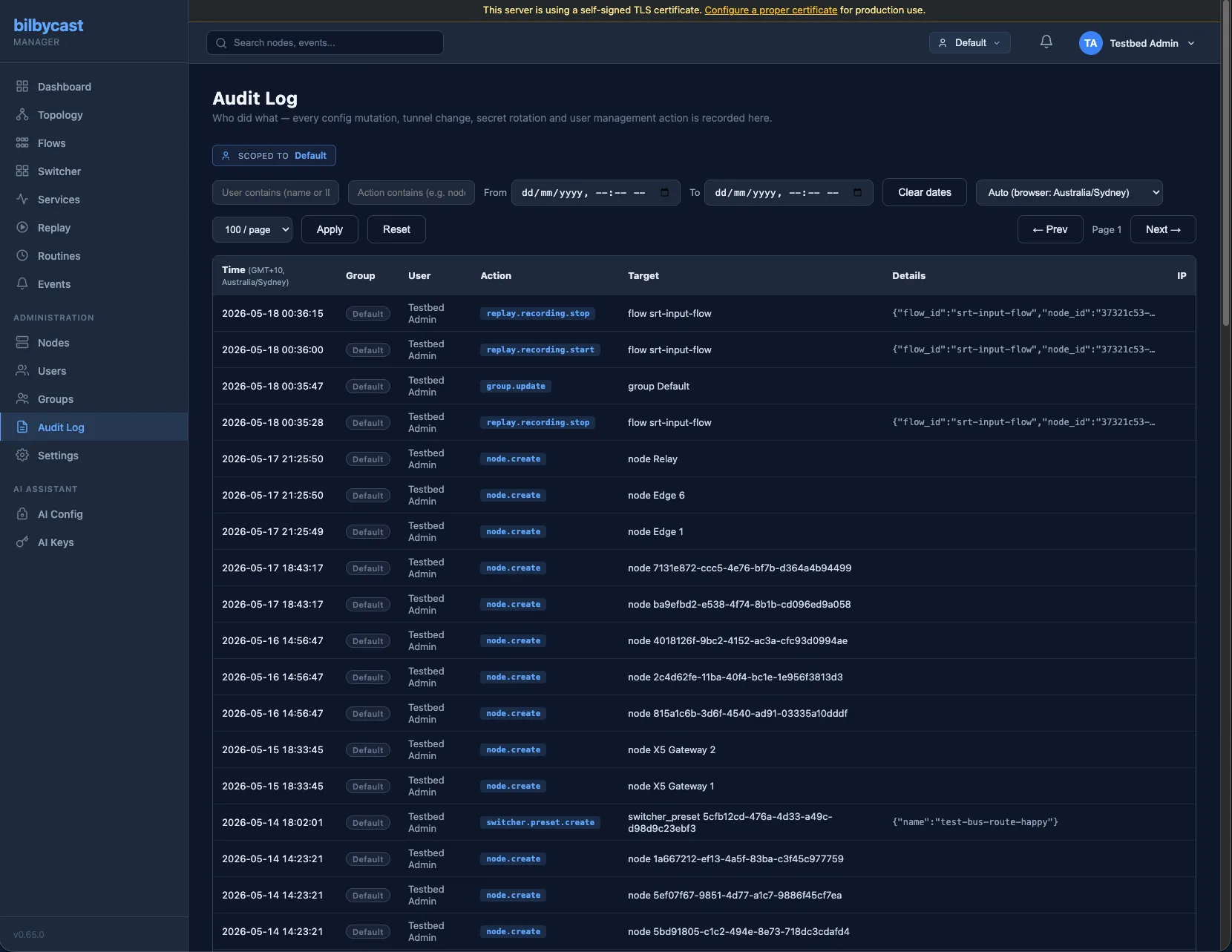
Every operator action, logged.
Group-scoped audit table with timestamp, user, action, target, and structured details — searchable by date range, action type, and target. Tenant-scoped: SuperAdmin sees everything; an Acme operator never sees Globex's history. Read-only by design — no API path deletes rows.
- Switcher takes, routine fires, node CRUD, flow edits, AI-driven actions — all recorded
- Structured
detailscolumn holds the parameters of every action - AI-driven actions tagged with provider + model — full provenance for compliance reviews
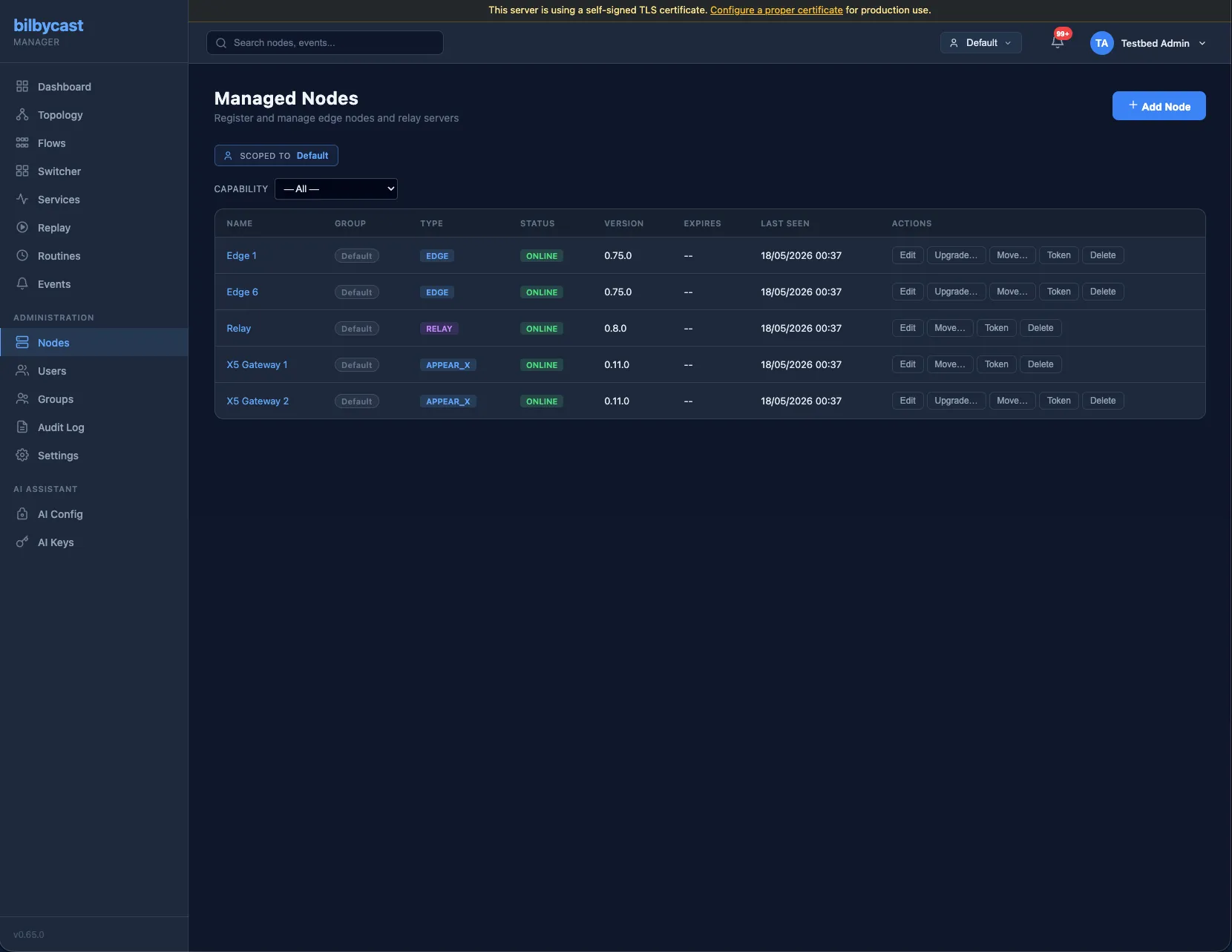
Roster view across the full plant — health, version, capabilities, last-seen status.
Set it up in 10 minutes.
Runs on commodity off-the-shelf hardware. Edge and relay are free under AGPL 3; manager is free for up to 10 nodes. No sign-up wall, no credit card. The same binaries you'd run in production.