
Manager Overview
bilbycast-manager is the centralized control plane for bilbycast. It provides a web dashboard, REST API, and WebSocket connectivity for real-time status, configuration, and control of distributed media transport nodes.
Key Features
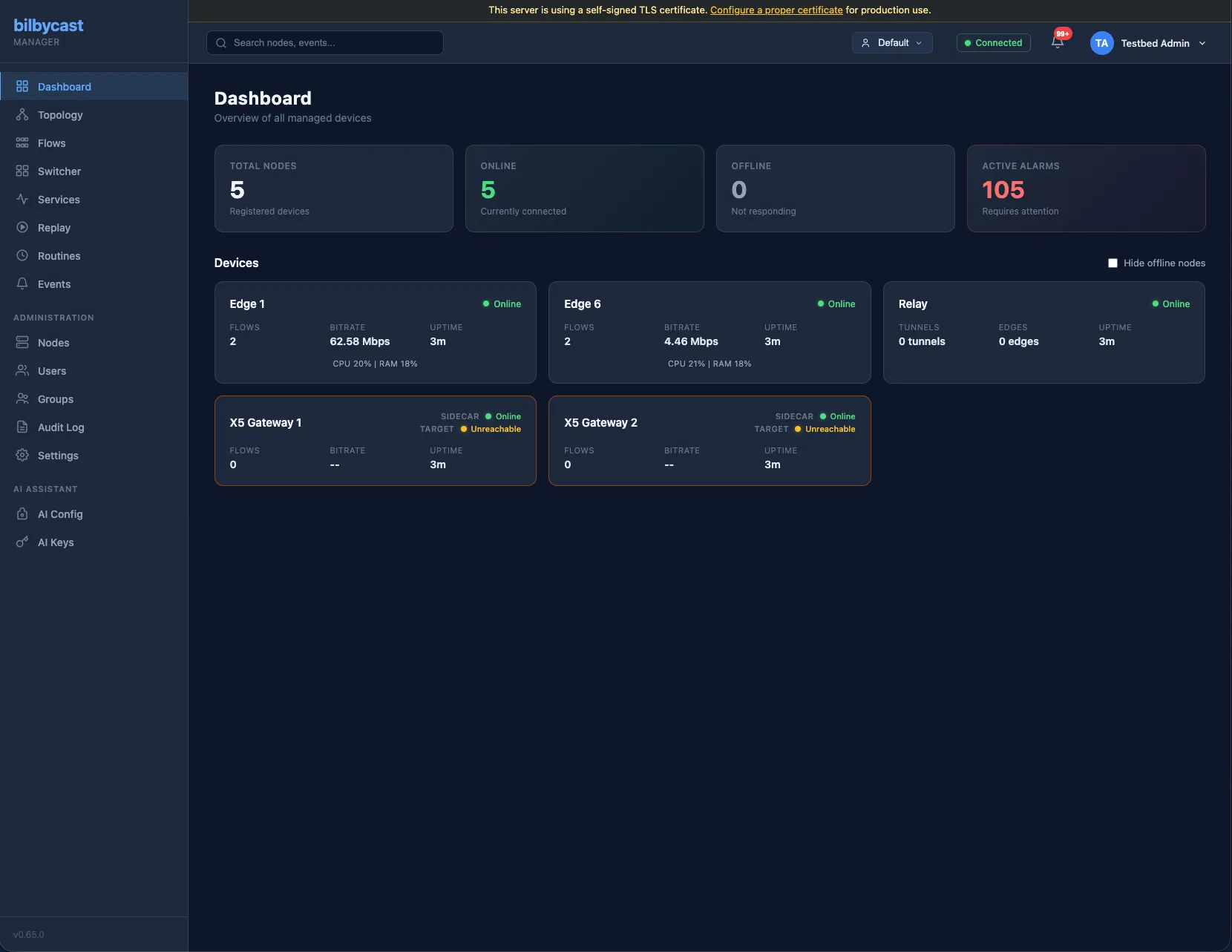
Section titled “Key Features”- Web dashboard — Real-time overview of all managed devices with status, flows, and bitrate.
- Network topology — Live visual map with graph and signal flow views.
- Node management — Register, configure, and monitor edge nodes and relay servers remotely.
- Live Switcher — In-browser PGM/PVW director console with Take semantics, presets, and per-tenant pages.
- Node Bus Matrix — Three-pane crosspoint authoring (Sources / Matrix / Inspector) for the node-wide ES bus. Click-to-wire and drag-and-drop equally first-class. Pending-state diffing with Apply / Discard. Salvo export captures a routing snapshot as a Switcher preset.
- Visual Flow Editor — Build a node’s configuration by drawing it on a canvas, with a draft → validate → preview → deploy cycle and a snapshot taken before every change. Master graphs put several units on one canvas and wire cross-unit transport between them.
- Aligned Output — Put two nodes forwarding the same feed on one shared timeline, so a downstream switcher can cut between them without a timing jump.
- Routines — Cron-scheduled named target state across flows, DST-correct via IANA timezones, with manual activation, skip-next-fire, and partial/failed/missed events.
- Multiviewer Walls — Author a wall in the browser — layout stage, tile routing, salvo save and recall — then deploy it to a unit that composites it and publishes it as an ordinary flow. Needs an edge advertising
mv-compositor. - Multiview — A grid of flow thumbnails the manager assembles by itself (2×2, 3×3, 4×4, or auto-fit up to 64 tiles), polled from the per-flow thumbnail endpoint. Still frames, and no edge capability gates the page — but a flow with thumbnails switched off reads Thumbnails off rather than a picture. A different surface from Multiviewer Walls above.
- Replay — Per-flow JKL scrub timeline, clip library, sport-tagging profiles, and one-click push-to-air on top of the edge replay server.
- Address Pools — Declared ranges of ports and multicast groups the manager allocates cross-unit connections from, with a record of who holds what.
- Services — Named, declarative, multi-device pipelines: pick a wizard, fill the form, Apply. The plan is executed step by step and rolled back in reverse on the first failure, and a background reconciler raises
service_driftwhen a device stops matching. Endpoints in the API Reference. - DVR Sessions — One browser-viewable, seekable feed per session: a source flow on an edge (a playback rendition plus a low-resolution all-intra proxy for jog and shuttle) bound to a relay that holds both for the length of the retention window. Every feed is gated — a revocable link for a one-off guest, a portal login for staff. The relay half is Viewer Distribution.
- Events & alarms — Every event raised by every managed node in one filterable log: severity, category, node, free-text search, date range, and a display timezone.
- Multi-tenant Groups — Per-tenant users, nodes, tunnels, switcher pages, routines, audit trail, quotas, and per-tenant logo + brand-colour theming. Access-control boundary only.
- On-edge Media Library — Browser upload + delete of slates, loops, and emergency-fallback content for the edge
media_playerinput, with quota enforcement. - AI assistant — Answers questions about the fleet, investigates problems and proposes configuration changes that an operator previews and applies; Anthropic, OpenAI, Gemini or a self-hosted OpenAI-compatible model, plus an MCP endpoint for external agents.
- Device driver pattern — Extensible architecture supporting edge nodes, relays, and third-party devices via vendor sidecars.
- Hybrid RBAC — Platform role (
user/super_admin) plus per-groupviewer/operator/adminmembership, with shared resources viaresource_shares. - MFA + SSO — TOTP second factor for local accounts; OIDC Single Sign-On (Authorization Code + PKCE) with optional group-sync — see Security.
- Encryption at rest — Envelope encryption (AES-256-GCM with per-domain HKDF-SHA256 KEKs) for every secret; one-shot master-key rotation via
rotate-master-key. - Encrypted backup & restore — Two passphrase-sealed paths: portable application-level export/import, and DR-grade
pg_dumparchive coordinated via Postgres advisory lock. - Active/Active HA — Two manager instances against a shared Postgres cluster, with cross-instance pubsub via LISTEN/NOTIFY and per-region observability on Prometheus metrics.
Architecture
Section titled “Architecture”The manager is a full-stack Rust application:
- Backend — Axum REST/WebSocket server backed by Postgres 18.
- Frontend — Embedded static HTML + vanilla JavaScript with hand-written CSS (
shared.css), served same-origin under an enforcing Content-Security-Policy (script-src 'self'). The Visual Flow Editor and Master Graphs pages additionally load a bundled React + xyflow canvas; there is no CSS framework. - Communication — All nodes connect outbound to the manager via WebSocket, enabling management of devices behind firewalls and NAT.
Device Driver Pattern
Section titled “Device Driver Pattern”The manager uses a driver-aware architecture where each device type has a registered driver:
| Driver | Device Type | Description |
|---|---|---|
| EdgeDriver | edge |
bilbycast-edge transport nodes |
| RelayDriver | relay |
bilbycast-relay servers |
| AppearXDriver | appear_x |
Appear X encoder/gateway units (via API gateway sidecar) |
New device types are added by implementing the DeviceDriver trait — the hub, database, API routes, and AI assistant work automatically for any registered driver.
Deployment
Section titled “Deployment”# Buildcargo build --release
# Initialize database and create first admin./target/release/bilbycast-manager setup --config config/default.toml
# Start the server./target/release/bilbycast-manager serve --config config/default.tomlRequired environment variables:
BILBYCAST_JWT_SECRET— 64-char hex string for JWT signingBILBYCAST_MASTER_KEY— 64-char hex string for AES-256-GCM encryption
See the Deployment Guide for full setup instructions and TLS configuration.