
Supported Protocols
Overview
Section titled “Overview”bilbycast-edge is a media gateway supporting multiple transport protocols for professional broadcast and streaming workflows.
Optional audio and video codec paths ship as Cargo features. The default build enables fdk-aac (in-process AAC via Fraunhofer FDK AAC) and media-codecs (FFmpeg libavcodec/libswscale for in-process video decode + JPEG encode + Opus/MP2/AC-3 audio encode). H.264/HEVC video encoding requires a video-encoder feature — video-encoder-x264 (GPL), video-encoder-x265 (GPL), video-encoder-nvenc (NVIDIA), video-encoder-qsv (Intel), or video-encoder-vaapi; the *-full release channel bundles all five (plus the matching HW decoders). The full video-encode reference, per-codec defaults, and licence breakdown live in bilbycast-edge/docs/transcoding.md in the repo.
Input Protocols
Section titled “Input Protocols”RTP (SMPTE ST 2022-2)
Section titled “RTP (SMPTE ST 2022-2)”- Direction: Input
- Transport: UDP unicast or multicast, IPv4 and IPv6
- Payload: MPEG-2 Transport Stream in RTP per SMPTE ST 2022-2
- Features:
- SMPTE 2022-1 FEC decode (column + row parity)
- IGMP/MLD multicast group join with interface selection
- Source IP allow-list filtering (RP 2129 C5)
- RTP payload type filtering (RP 2129 U4)
- Per-flow ingress rate limiting (RP 2129 C7)
- DSCP/QoS marking on egress (RP 2129 C10)
- VSF TR-07 mode: auto-detects JPEG XS streams
UDP (Raw MPEG-TS)
Section titled “UDP (Raw MPEG-TS)”- Direction: Input
- Transport: UDP unicast or multicast, IPv4 and IPv6
- Payload: Raw MPEG-TS datagrams (no RTP headers required)
- Features:
- Accepts any UDP datagram (no RTP v2 header filtering)
- IGMP/MLD multicast group join with interface selection
- Compatible with OBS, ffmpeg
udp://output, srt-live-transmit, VLC
SRT (Secure Reliable Transport)
Section titled “SRT (Secure Reliable Transport)”- Direction: Input
- Transport: UDP with ARQ retransmission
- Modes: Caller, Listener, Rendezvous
- Features:
- AES-128/192/256 encryption (AES-CTR default, AES-GCM authenticated encryption selectable via
crypto_mode) - Stream ID access control (
stream_id, max 512 chars per SRT spec; supports#!::r=name,m=mode,u=userstructured format) - FEC (Forward Error Correction) via
packet_filter— XOR-based row/column parity, staircase layout, ARQ integration modes (always/onreq/never), wire-compatible with libsrt v1.5.7 - Configurable latency buffer (symmetric or asymmetric receiver/sender latency)
- Retransmission bandwidth capping (Token Bucket shaper via
max_rexmit_bw) - SMPTE 2022-7 hitless redundancy merge (dual-leg input)
- Automatic reconnection
transport_mode: "audio_302m"(deferred — see Audio Gateway — Limitations): demux SMPTE 302M LPCM-in-MPEG-TS fromffmpeg -c:a s302m,srt-live-transmit, or hardware encoders, and republish as RTP audio packets onto the broadcast channel
- AES-128/192/256 encryption (AES-CTR default, AES-GCM authenticated encryption selectable via
RIST (VSF TR-06-1 Simple Profile)
Section titled “RIST (VSF TR-06-1 Simple Profile)”- Direction: Input and Output
- Transport: UDP with RTCP NACK-driven retransmission
- Implementation:
bilbycast-rist, a two-crate workspace (rist-protocol+rist-transport). Wire-verified against librist 0.2.11ristsender/ristreceiver - Features:
- Reliable RTP over UDP with RTCP NACK retransmission, RTT echo, SDES, and NTP-aligned RTP timestamps
- Dynamic RTCP source-address learning so receivers work through NAT
- SMPTE 2022-7 bonding handled in the protocol layer (not just at the broadcast channel)
- MPTS passthrough or per-output MPTS→SPTS filter via
program_number - Optional
audio_encodeon the TS (same codec matrix as SRT / UDP / RTP) - Optional
video_encodeon the TS (same encoders as SRT / UDP / RTP) - Optional output
delayblock (fixed,target_ms,target_frames)
rtp_audio (RFC 3551 PCM over RTP, no PTP)
Section titled “rtp_audio (RFC 3551 PCM over RTP, no PTP)”- Direction: Input and Output
- Transport: UDP unicast or multicast, IPv4 and IPv6
- Payload: Big-endian L16 or L24 PCM in standard RFC 3551 RTP
- Why it exists: Wire-identical to SMPTE ST 2110-30 but with relaxed
constraints — sample rates 32 / 44.1 / 48 / 88.2 / 96 kHz, no PTP
requirement, no RFC 7273 timing reference, no NMOS
clock_domainadvertising. Use this for radio contribution feeds over the public internet, talkback between studios that don’t share a PTP fabric, and ffmpeg / OBS / GStreamer interop where ST 2110-30’s PTP assumption is overkill. - Features:
- Same
transcodeblock as ST 2110-30 outputs (sample-rate / bit-depth / channel routing — see Audio Gateway) - SMPTE 2022-7 dual-leg redundancy
- Source IP allow-list filtering
- Output also supports
transport_mode: "audio_302m"to wrap the audio as SMPTE 302M-in-MPEG-TS inside RFC 2250 RTP/MP2T (PT 33) — useful for hardware decoders that consume MPEG-TS over RTP
- Same
Bonded (multi-path aggregation)
Section titled “Bonded (multi-path aggregation)”- Direction: Input and Output
- Transport: N heterogeneous aggregation legs over UDP or QUIC (RFC 9221 DATAGRAM), chosen per-leg. (RIST is unidirectional at the bond layer, so it is not selectable as an aggregation leg.)
- Payload: Any bytes — MPEG-TS, RTP, or raw — framed inside a 12-byte bond header with a 32-bit sequence across all paths
- Scheduler:
adaptivedefault (walks H.264/HEVC NAL units and duplicates IDR frames across the two best paths, and discovers each leg’s usable capacity so the split tracks measured bandwidth),media_aware(legacy RTT-only split),weighted_rtt, orround_robin - Why it exists: Carrier-grade path aggregation for broadcast — the capability typically sold as a dedicated bonded-cellular encoder or SD-WAN bonding appliance, built directly into the edge. Outperforms per-protocol bonding (SRT groups, RIST 2022-7) on mixed-link heterogeneous scenarios, with frame-accurate failover via IDR duplication rather than stream-wide doubling
- Features:
- NACK-driven ARQ over a 32-bit sequence space with per-path retransmit targeting
- Reassembly buffer with configurable
hold_msfor late-arrival tolerance - Per-path keepalives → live RTT, jitter, loss, throughput stats exposed through the manager UI and Prometheus
- QUIC paths negotiate ALPN
bilbycast-bond(self-signed dev mode and production PEM mode both supported) - Output-side MTU-fit re-chunking via an optional
path_mtuknob (default 1500, range 576–9000): the bonded output re-chunks outbound TS at 188-byte boundaries into datagrams that fit the smallest leg’s IP path MTU after all per-datagram overhead, so no leg emits an IP-fragmented datagram. Essential on cellular CGNAT bearers that silently drop fragments and black-hole PMTU discovery — set it to the measured MTU (e.g. ~1000 B → 4 × 188 = 752 B datagrams). Sender-side only; the receiver reassembles regardless of datagram size. See Multi-Path Bonding program_numberfilter on the output side for MPTS → SPTS down-selection before bonding
- When not to use it: Use libsrt socket groups for two SRT legs to the same receiver, RIST SMPTE 2022-7 for two RIST legs. Bonded is the universal option for N ≥ 2 heterogeneous links carrying any inner protocol — see Multi-Path Bonding for the full reference.
Synthetic / local inputs (test_pattern, media_player, replay, mosaic)
Section titled “Synthetic / local inputs (test_pattern, media_player, replay, mosaic)”- Direction: Input
test_pattern— a synthetic colour-bar / test-raster generator (optional screen-ID text, tone/beep ident, A/V-sync sweep) muxed as a paced MPEG-TS. No external source needed — handy for standing up and validating a flow.media_player(defaultmedia-codecsbuild) — replays a playlist of local assets (TS / MP4 / MOV / still image) from the edge media library as a paced fresh MPEG-TS:loop_playback,shuffle, optionalpaced_bitrate_bps(TS only), and optional MPTS→SPTSprogram_number.replay(default-onreplayfeature) — plays a recorded clip or recording back into a flow as a fresh input, driven by the replay command channel (cue / play / scrub). See Replay.mosaic(multiviewerfeature — off in a plaincargo build, on in all three release artefacts) — the one input type that consumes other node-local inputs. It composites their video onto a single canvas (width/height/fps/video_bitrate_kbps/codecplus atileslist) and republishes the result as a paced MPEG-TS, so a multiviewer wall is an ordinary flow source and reaches any output the edge already has. Because the flow bus carries TS, the canvas has to be encoded — a build without avideo-encoder-*feature does not advertisemv-compositorand the manager hides the surface. See Multiviewer.
Output Protocols
Section titled “Output Protocols”RTP (SMPTE ST 2022-2)
Section titled “RTP (SMPTE ST 2022-2)”- Direction: Output
- Transport: UDP unicast or multicast
- Payload: RTP-wrapped MPEG-TS packets with RTP headers
- Features:
- SMPTE 2022-1 FEC encode
- DSCP/QoS marking (default: 46 Expedited Forwarding)
- Multicast with interface selection
- MPTS passthrough (default) or optional MPTS→SPTS program filter via
program_number
UDP (Raw MPEG-TS)
Section titled “UDP (Raw MPEG-TS)”- Direction: Output
- Transport: UDP unicast or multicast
- Payload: Raw MPEG-TS datagrams (7×188 = 1316 bytes, no RTP headers)
- Features:
- Strips RTP headers when input is RTP-wrapped
- TS sync detection and packet alignment
- DSCP/QoS marking
- Compatible with ffplay, VLC, multicast distribution
- MPTS passthrough (default) or optional MPTS→SPTS program filter via
program_number transport_mode: "audio_302m": when the upstream input is an audio essence, run the per-output transcode + SMPTE 302M packetizer + TsMuxer pipeline and emit 7×188-byte MPEG-TS chunks containing 48 kHz LPCM (16/20/24 bit, 2/4/6/8 channels) as plain UDP datagrams. Useful for legacy hardware decoders that consume raw MPEG-TS over UDP. Mutually exclusive withprogram_number. See Audio Gateway for the full pipeline.
SRT (Secure Reliable Transport)
Section titled “SRT (Secure Reliable Transport)”- Direction: Output
- Modes: Caller, Listener, Rendezvous
- Features:
- AES encryption (AES-CTR or AES-GCM via
crypto_mode) - Stream ID access control (
stream_id, max 512 chars; callers send during handshake, listeners filter) - FEC (Forward Error Correction) via
packet_filter— same capabilities as SRT input - Asymmetric latency support (independent receiver/sender latency)
- Retransmission bandwidth capping (Token Bucket shaper)
- SMPTE 2022-7 hitless redundancy duplication (dual-leg output)
- Non-blocking mpsc bridge prevents TCP backpressure from affecting other outputs
- Automatic reconnection
- MPTS passthrough (default) or optional MPTS→SPTS program filter via
program_number transport_mode: "audio_302m": when the upstream input is an audio essence, run the per-output transcode (force 48 kHz, even channels, 16/20/24-bit) + SMPTE 302M packetizer + TsMuxer (BSSD registration descriptor in PMT) + 1316-byte chunk bundling pipeline. Interoperable withffmpeg -c:a s302m,srt-live-transmit, and broadcast hardware decoders that expect 302M LPCM in MPEG-TS over SRT. Mutually exclusive withpacket_filter,program_number, and 2022-7 redundancy. See Audio Gateway for the full pipeline, interop tests, and worked use cases.
- AES encryption (AES-CTR or AES-GCM via
RTMP/RTMPS
Section titled “RTMP/RTMPS”- Direction: Input (publish) and Output (publish)
- Transport: TCP (RTMP) or TLS over TCP (RTMPS)
- Use case: Delivering to Twitch, YouTube Live, Facebook Live; ingesting from OBS, Wirecast, ffmpeg
- Features:
- Native RTMP protocol implementation (handshake, chunking, AMF0)
- Demuxes H.264 and AAC from MPEG-2 TS, muxes into FLV
- Automatic AVC sequence header (SPS/PPS) and AAC config generation
- Reconnection with configurable delay and max attempts
- Non-blocking: uses mpsc bridge pattern, never blocks other outputs
- MPTS-aware: on an MPTS input, selects program by
program_numberor (default) locks onto the lowest-numbered program in the PAT - Optional
audio_encodeblock (Phase B): re-encodes audio so the operator can normalise bitrate / sample rate / channel count or upgrade to HE-AAC v1/v2 (aac_lc,he_aac_v1,he_aac_v2). With the defaultfdk-aacfeature, AAC codecs encode in-process via FDK AAC (no ffmpeg needed). Same-codec passthrough fast path skips both decoder and encoder when the source is already AAC-LC and no overrides are set. Outputs withoutaudio_encodekeep working without ffmpeg installed. See Audio Gateway —audio_encode. - Optional
video_encodeblock: H.264 targets emit classic FLV; HEVC targets emit Enhanced RTMP v2 extended VideoTagHeader (hvc1FourCC, hvcC assembled from the encoder’s extradata). RTMP HEVC passthrough (novideo_encode) also rides the E-RTMP path, with hvcC built from the demuxer’s cached VPS/SPS/PPS.
- Limitations:
- RTMPS (TLS) uses the
tlsfeature (enabled by default). - Single-program by spec — only one program can be published per output.
- RTMPS (TLS) uses the
HLS Egress
Section titled “HLS Egress”- Direction: Output only
- Transport: HTTP PUT/POST over TCP
- Use case: YouTube HLS ingest (supports HEVC/HDR content)
- Features:
- Segments MPEG-2 TS data into time-bounded chunks
- Generates rolling M3U8 playlist
- Configurable segment duration (0.5-10 seconds)
- Optional Bearer token authentication
- Async HTTP upload, non-blocking to other outputs
- MPTS passthrough (default) or optional MPTS→SPTS program filter via
program_number— filtered segments carry a rewritten single-program TS - Optional
audio_encodeblock (Phase B): each segment is re-encoded with the configured audio codec and re-muxed back into MPEG-TS in-process (video PIDs pass through unchanged). Allowed codecs:aac_lc,he_aac_v1,he_aac_v2,mp2,ac3. AAC codecs use the in-process FDK AAC encoder (defaultfdk-aacfeature); MP2 / AC-3 use in-process libavcodec on the defaultmedia-codecsbuild, with an ffmpeg subprocess fallback when the feature is disabled.
- Limitations:
- Output only. Segment-based transport inherently adds 1-4 seconds of latency.
- Uses a minimal built-in HTTP client (not a full HTTP/2 client).
CMAF / CMAF-LL
Section titled “CMAF / CMAF-LL”- Direction: Output only
- Transport: HTTP(S) PUT to an ingest endpoint
- Use case: OTT distribution to CDNs that accept fragmented MP4 (CloudFront, Akamai, Fastly, bespoke origins) with simultaneous HLS (Apple) and MPEG-DASH (Widevine/PlayReady) player reach, low-latency live, and DRM-protected streams.
- Implementation: hand-rolled ISO-BMFF box writer (no MP4 crate dependency) in
engine/cmaf/. Sibling of the HLS output with fragmented MP4 segments instead of TS. - Features:
- Dual manifests: emits
.m3u8(HLS) and.mpd(DASH) off the same CMAF segment set — operators reach Apple and DASH players with a single push.manifestsis a subset of["hls", "dash"](default both). - Standard CMAF: whole-segment HTTP PUT — target
segment_duration_secs(1.0-10.0, default 2.0), rolling playlist ofmax_segments(1-30, default 5). - Time-based DVR window:
dvr_window_secs(float, >= 1.0) supersedesmax_segments— the playlist length is derived asceil(dvr_window_secs / segment_duration_secs), so the window stays the duration you asked for if the segment length changes. Refused above 21600 derived entries (every viewer refetches the whole playlist each segment). The window slides: it advertises only what the origin still holds, so size origin retention to match or clients will seek to evicted segments. - Low-latency CMAF (LL-CMAF):
low_latency: trueenables chunked-transfer PUT +#EXT-X-PARTin HLS and DASHavailabilityTimeOffset. Chunk cadence set bychunk_duration_ms(100-2000, default 500). Sub-second end-to-end latency on a well-tuned CDN. - Video passthrough or re-encode: H.264 and HEVC source streams ride unchanged by default. Setting
video_encodeforces aVideoDecoder→VideoEncoderpipeline (x264/x265/NVENC, same schema as other outputs); segments still cut on IDR, and the re-encoder pins a 60-frame GoP unless you setvideo_encode.gop_sizeyourself — it is not derived fromsegment_duration_secs, so set both if you want them to line up.video_encode.codecmust name an explicit backend (x264,x265,h264_nvenc,hevc_nvenc,h264_qsv,hevc_qsv,h264_vaapi,hevc_vaapi,h264_rkmpp,hevc_rkmpp) — the*_autoaliases every TS output accepts are refused at validation, because the CMAF re-encoder does not resolve them. HEVC output is DASH-only — HLS fMP4 HEVC (hvc1) playback support varies by client, so prefermanifests: ["dash"]when encoding to HEVC. - HEVC
hvc1/hev1signalling: DASH MPD carries the codec FourCC in the<Representation codecs="...">attribute; iOS Safari compatibility driveshvc1by default. - Audio passthrough or re-encode: AAC sources ride unchanged by default. Setting
audio_encoderuns the decode → optionaltranscode→ re-encode pipeline with the AAC family only (aac_lc,he_aac_v1,he_aac_v2). MP2, AC-3, and Opus are not valid for CMAF. - ClearKey CENC encryption (ISO/IEC 23001-7 Common Encryption). Two schemes:
cenc— AES-CTR. Widevine and PlayReady standard. Pairs with DASH for the broadest DRM reach.cbcs— AES-CBC with 1:9 pattern. FairPlay / Apple standard. Pairs with HLS for iOS / tvOS.
- DRM bring-your-own: the edge emits a W3C EME ClearKey
psshbox automatically; operators can additionally supply pre-built Widevine, PlayReady, and FairPlaypsshboxes viaencryption.pssh_boxesand the edge copies them verbatim into the init segment’smoov. Commercial DRM license servers are operator-managed (not part of bilbycast). - Subsample encryption keeps video NAL prefixes and parameter sets in the clear (first ~32 bytes per NAL), encrypts the rest.
senc/saio/saizboxes per segment. - Optional Bearer auth on uploads via
auth_token. - Scrub-preview thumbnail track: an optional
thumbnailsblock (interval_secs1-30 default 2,frames_per_sheet1-200 default 20,width64-640 default 160,height36-360 default 90) publishes sprite sheets plus a WebVTT index beside the media, so a browser player can show a picture while the operator drags the scrub bar. It rides the broadcast as a sibling subscriber and can never stall the output. Needs the default-onreplayfeature, which owns the frame capture — a build without it runs the output and warns rather than silently publishing nothing. Validation refuses a sheet over 4096 px on either axis, and refusesinterval_secs x frames_per_sheetgreater than or equal to the playlist window (dvr_window_secswhen set, otherwisemax_segments x segment_duration_secs): a sheet is only published once it is full, so a longer lag than the window means no sheet ever describes a segment the playlist still lists. Note what that implies for the defaults — 2 s x 20 frames is 40 s of lag against a 10 s default playlist, so a thumbnail track in practice comes with advr_window_secslong enough to cover it. - MPTS filtering: optional
program_numberselector filters an MPTS input to a single program before segmenting. - Never blocks the broadcast subscriber: all codec work runs in
tokio::task::block_in_place; the LL-CMAF chunked upload uses a boundedmpsc(8)with drop-on-full semantics so a slow CDN can’t back-pressure the rest of the flow.
- Dual manifests: emits
- Limitations:
- Output only — bilbycast-edge does not ingest its own CMAF output (the playback side is any compliant HLS or DASH player).
- HLS fMP4 HEVC clients are inconsistent; re-encoding to HEVC → HLS typically fails on older Apple devices. Recommended:
manifests: ["dash"]when re-encoding HEVC, or stick to H.264 when serving HLS. transcoderequiresaudio_encodeto be set — it has no effect on passthrough audio and is rejected at validation.encryptionandlow_latency: trueare mutually exclusive. The chunked LL path writes nosenc/saiz/saioand applies no CENC transform, so the media would go out in the clear under a config that says it is encrypted. Validation refuses the combination and the flow does not start, rather than warning — setlow_latency: falsefor an encrypted output, or dropencryptionif latency matters more (bilbycast-edge#135).
- Reference: see Configuration — CMAF Output for the field table and worked examples, and
bilbycast-edge/docs/cmaf.mdin the repo for the implementation deep-dive (threading model, segment boundary semantics, DASH manifest profile, CENC subsample algorithm).
- Direction: Input only
- Transport: TCP (interleaved) or UDP
- Client library:
retina - Features:
- Pull H.264 or H.265/HEVC video and AAC audio from IP cameras and media servers
- Digest and Basic authentication support
- TCP interleaved (default, works through firewalls) or UDP transport
- Automatic reconnection with configurable delay
- Received media is muxed into MPEG-TS with proper PAT/PMT program tables
- Audio-only streams supported (PAT/PMT emitted even without video)
- Limitations:
- Input only (no RTSP server mode)
- AAC audio is passed through as ADTS in MPEG-TS
SMPTE ST 2110-20 / -23 (uncompressed video)
Section titled “SMPTE ST 2110-20 / -23 (uncompressed video)”- Direction: Input and Output
- Transport: RFC 4175 RTP/UDP, multicast or unicast
- Payload: YCbCr 4:2:2 8-bit or 10-bit uncompressed. ST 2110-23 adds two partition modes on top of -20: 2SI (two-sample interleave) for UHD over multiple 10 GbE pipes, and sample-row for higher framerates
- PTP: Best-effort PTP slave via external
ptp4l— same wiring as the audio essences - Dual-network: SMPTE 2022-7 Red/Blue bind on input and output
- Egress pipeline: The flow’s MPEG-TS video ES is demuxed, decoded via
video-engine::VideoDecoder, scaled into planar 4:2:2 8/10-bit viaVideoScaler, then RFC 4175-packetised onto the wire (Red plus optional Blue). Outputs only need the defaultmedia-codecsfeature - Ingress pipeline: RFC 4175 depacketise to raw frames, feed through
video-engine::VideoEncoderin a blocking worker, thenTsMuxerinto the flow. Inputs require avideo_encodeblock and a compiled-invideo-encoder-*feature (libx264, libx265, or NVENC) - Status: Phase 2 shipped. ST 2110-22 (JPEG XS) is deferred pending a libjxs wrapper crate
- NMOS: Advertised as
urn:x-nmos:format:videoin IS-04, with BCP-004 receiver caps reflecting the configured width/height/framerate/sampling
SMPTE ST 2110-30 / -31 (PCM / AES3 audio)
Section titled “SMPTE ST 2110-30 / -31 (PCM / AES3 audio)”- Direction: Input and Output
- Transport: RFC 3551 RTP/UDP, multicast or unicast, with IGMP/MLD multicast group join and interface selection
- Payload: Big-endian L16/L24 PCM (-30) or AES3 sub-frames (-31, always 24-bit, transparent to Dolby E and AES3 user/channel-status bits)
- Wire constraints: sample_rate 48000 / 96000 Hz; bit_depth 16 or 24; channels 1, 2, 4, 8, 16; packet_time 125 / 250 / 333 / 500 / 1000 / 4000 µs; payload_type 96–127
- PTP: best-effort PTP slave via the external
ptp4ldaemon’s management Unix socket. PTP state surfaces through stats; no in-process PTP daemon ships with the edge. - Features:
- SMPTE 2022-7 dual-network (“Red”/“Blue”) bind on input and output,
with hitless merge on input via
engine::st2110::redblue::RedBluePair - Source IP allow-list filtering (single-leg only)
- Per-output PCM transcode (
transcodeblock): sample-rate / bit-depth / channel-routing conversion via the lock-freeengine::audio_transcodestage. IS-08 channel-map activations propagate without flow restart via atokio::sync::watchchannel — see Audio Gateway for the full feature set, presets, and worked examples. - Compressed-audio ingress (Phase A): when the upstream flow input is AAC in MPEG-TS (carried over RTMP / RTSP / SRT / UDP / RTP), the in-process
engine::audio_decode::AacDecoderturns it into f32 planar PCM so ST 2110-30 / -31 outputs — and thesrt/udp/rtp_audio302M output modes — can carry it without ffmpeg. Default FDK AAC backend supports AAC-LC, HE-AAC v1/v2, and multichannel up to 7.1; symphonia fallback supports AAC-LC mono/stereo only.
- SMPTE 2022-7 dual-network (“Red”/“Blue”) bind on input and output,
with hitless merge on input via
- NMOS: advertised as
urn:x-nmos:format:audioin IS-04, with BCP-004 receiver caps reflecting the configured sample rate, channel count, and sample depth
SMPTE ST 2110-40 (ancillary data)
Section titled “SMPTE ST 2110-40 (ancillary data)”- Direction: Input and Output
- Transport: RFC 8331 RTP/UDP
- Payload: Bit-packed RFC 8331 ANC (SCTE-104 ad markers, SMPTE 12M timecode, CEA-608/708 captions, AFD, CDP)
- Features:
- Same SMPTE 2022-7 dual-network and source allow-list options as -30/-31
- SCTE-104 messages auto-detected and emitted as
scte104events
- NMOS: advertised as
urn:x-nmos:format:datain IS-04. Receivers advertisemedia_types: ["video/smpte291"].
WebRTC (WHIP/WHEP)
Section titled “WebRTC (WHIP/WHEP)”- Direction: Input and Output
- Transport: UDP (ICE-lite/DTLS/SRTP) via the
str0mWebRTC stack - Status: Fully implemented. The
webrtcfeature is enabled by default. - Four modes:
- WHIP input (server): Accept contributions from OBS, browsers — endpoint at
/api/v1/flows/{id}/whip - WHIP output (client): Push media to external WHIP endpoints (CDN, cloud) — or to a bilbycast relay’s viewer-distribution ingest to reach browser viewers natively (WHEP SFU + LL-HLS), with no external streaming server and no ports opened on the edge
- WHEP output (server): Serve browser viewers — endpoint at
/api/v1/flows/{id}/whep - WHEP input (client): Pull media from external WHEP servers
- WHIP input (server): Accept contributions from OBS, browsers — endpoint at
- Video: H.264 only on egress (browsers don’t decode HEVC over WebRTC). HEVC sources are auto-transcoded to H.264 by the same
VideoDecoder/VideoEncoderpair used for explicitvideo_encode— drop an HEVC SRT feed onto a WHEP output and browsers just work. Validation rejectsx265/hevc_nvenctargets for WebRTC outputs. The encoder is opened withglobal_header = falseso SPS/PPS ride in-band on every IDR and the RFC 6184 packetizer forwards them as ordinary NAL units - Audio: Opus passthrough by default — Opus flows natively on WebRTC paths and gets muxed into MPEG-TS for SRT/RIST/RTP/UDP outputs. Without
audio_encode, AAC sources going to a WebRTC output automatically fall back to video-only. Setting anaudio_encodeblock (codec:opus) enables the Phase B chain: input AAC is decoded in-process via the Phase Aengine::audio_decode::AacDecoder(FDK AAC by default, supporting AAC-LC / HE-AAC v1/v2 / multichannel) and re-encoded as Opus in-process via libavcodec + libopus (on the defaultmedia-codecsbuild; ffmpeg subprocess fallback when the feature is disabled), then written to the WebRTC audio MID via str0m. This is the marquee Phase A+B chain — AAC RTMP contribution → Opus WebRTC distribution — all inside one bilbycast-edge process with no external transcoder. Requiresvideo_only=false. - MPTS-aware outputs: on an MPTS input, WHIP/WHEP outputs select program by
program_numberor (default) lock onto the lowest-numbered program in the PAT. Single-program by spec. - Interoperability: Compatible with OBS, browsers, Cloudflare, LiveKit, and other standard WHIP/WHEP implementations.
- Security: Bearer token authentication on WHIP/WHEP endpoints, DTLS/SRTP encryption, ICE-lite for server modes.
- NAT traversal: Configurable
public_ipand optionalstun_serverfor ICE candidate advertisement.
SDI (Blackmagic DeckLink) — sdi-decklink feature
Section titled “SDI (Blackmagic DeckLink) — sdi-decklink feature”- Direction: Input and Output (
type: "sdi") - Status: Off in a plain
cargo build, but compiled into every*-fullrelease artefact on both arches (when the DeckLink SDK headers are available at build time). Also needsmedia-codecs(default on). Talks to the Blackmagic DeckLink SDK directly through the siblingbilbycast-decklink-rscrate — not FFmpeg’sdecklinkavdevice (which hidesbmdFrameHasNoInputSource, making a pulled cable look like a live feed). - Input (capture): UYVY422 8-bit capture → encoder (x264 / x265 / NVENC /
QSV / VAAPI /
*_auto) + embedded-PCM → AAC → MPEG-TS onto the flow. VANC extraction covers SCTE-104/35 (translated to a SCTE-35 PID), SMPTE 12M ATC timecode, and CEA-608/708 caption presence. Signal loss raisessdi_signal_lost/sdi_signal_restoredevents. - Output (playout): decode the flow’s video + audio and play out to the card with hardware A/V sync and optional SCTE-35→SCTE-104 VANC injection.
- Runtime:
libDeckLinkAPI.so(Blackmagic Desktop Video) isdlopened; the boot probe enumerates cards and advertises thesdi-decklinkcapability only on success, so a host with no card simply doesn’t offer SDI. Per-port hardware health ridesHealthPayload.sdi_devices[].
MXL (Media eXchange Layer) — mxl feature
Section titled “MXL (Media eXchange Layer) — mxl feature”- Direction: Input and Output (
mxl_video/mxl_audio/mxl_anc) - Status: Off by default (heavy build prerequisites). EBU / Linux Foundation same-host shared-memory bus mirroring the ST 2110-20/-30/-40 pattern for cloud-native broadcast composition. The MXL video bridge (V210 ↔ H.264/HEVC) is implemented; the MXL audio bridge is currently a stub.
- PTP: mandatory at validation time (
master_clock = wallclockis rejected on MXL flows). The boot probedlopenslibmxl.soand only advertises themxl-video/mxl-audio/mxl-anccapability bits on success. - Reference: dedicated MXL page for config, install, and capability details.
Local-display output (HDMI / DisplayPort + ALSA) — display feature
Section titled “Local-display output (HDMI / DisplayPort + ALSA) — display feature”- Direction: Output only (
type: "display") - Status:
displayfeature is on by default (Linux-only effect). Decodes the flow’s video + audio and renders to a KMS connector (HDMI / DisplayPort) plus an ALSA audio device — a confidence / playout monitor with no network egress. - Pipeline: demux + decode (H.264 / HEVC video, AAC / MP2 / AC-3 / E-AC-3 / Opus audio) → KMS/DRM atomic-commit page flip (zero-copy VAAPI DMA-BUF scanout where available, CPU-blit fallback otherwise) + blocking ALSA playback. A/V sync is audio-master. Optional audio-bars overlay, HDR-on-HDR passthrough with HDR-on-SDR tonemap fallback, and bob deinterlacing.
- Runtime: capability
"display"advertised only when the feature is on and at least one KMS connector enumerates;HealthPayload.display_devicesdrives the manager UI’s connector dropdown.
MPEG-TS Program Handling
Section titled “MPEG-TS Program Handling”MPTS / SPTS Support
Section titled “MPTS / SPTS Support”- All TS-carrying inputs (UDP, RTP, SRT) accept both SPTS (single-program) and MPTS (multi-program) transport streams. Non-TS inputs (RTMP, RTSP, WebRTC) synthesise a single-program TS internally.
- TS-native outputs (UDP, RTP, SRT, HLS) pass the full MPTS through by default. Each output may opt into a per-program filter via
program_number, which rewrites the PAT to a single-program form and drops packets for every PID that isn’t part of the selected program. FEC (2022-1) and hitless redundancy (2022-7) protect the filtered bytes, so receivers see a valid SPTS. - Re-muxing outputs (RTMP, WebRTC) and the thumbnail generator honour the same
program_numberfield to select which program’s elementary streams to extract. The default (unset) locks onto the lowestprogram_numberin the PAT for deterministic behaviour. - Per-output scope: one flow can fan an MPTS out to multiple outputs, each locked onto a different program, while a sibling output forwards the full MPTS unchanged.
Video Transcoding (video_encode)
Section titled “Video Transcoding (video_encode)”SRT, RIST, UDP, RTP, RTMP, CMAF, and WebRTC outputs accept an optional video_encode block. TS-carrying outputs (SRT / RIST / UDP / RTP) run the streaming engine::ts_video_replace::TsVideoReplacer: the source video ES is demuxed, decoded via video-engine::VideoDecoder, re-encoded via video-engine::VideoEncoder, and re-muxed into the output TS — non-video PIDs (audio, PCR, PSI, ST 2110-40 ANC) pass through untouched. RTMP drives the same decoder/encoder pair, emitting classic FLV for H.264 targets and Enhanced RTMP v2 (hvc1 FourCC, hvcC extradata) for HEVC targets. WebRTC is H.264-only and auto-transcodes HEVC sources. CMAF re-encodes into its fragmented-MP4 segments, and is the one output that needs an explicit backend rather than an *_auto alias — see the CMAF / CMAF-LL section above.
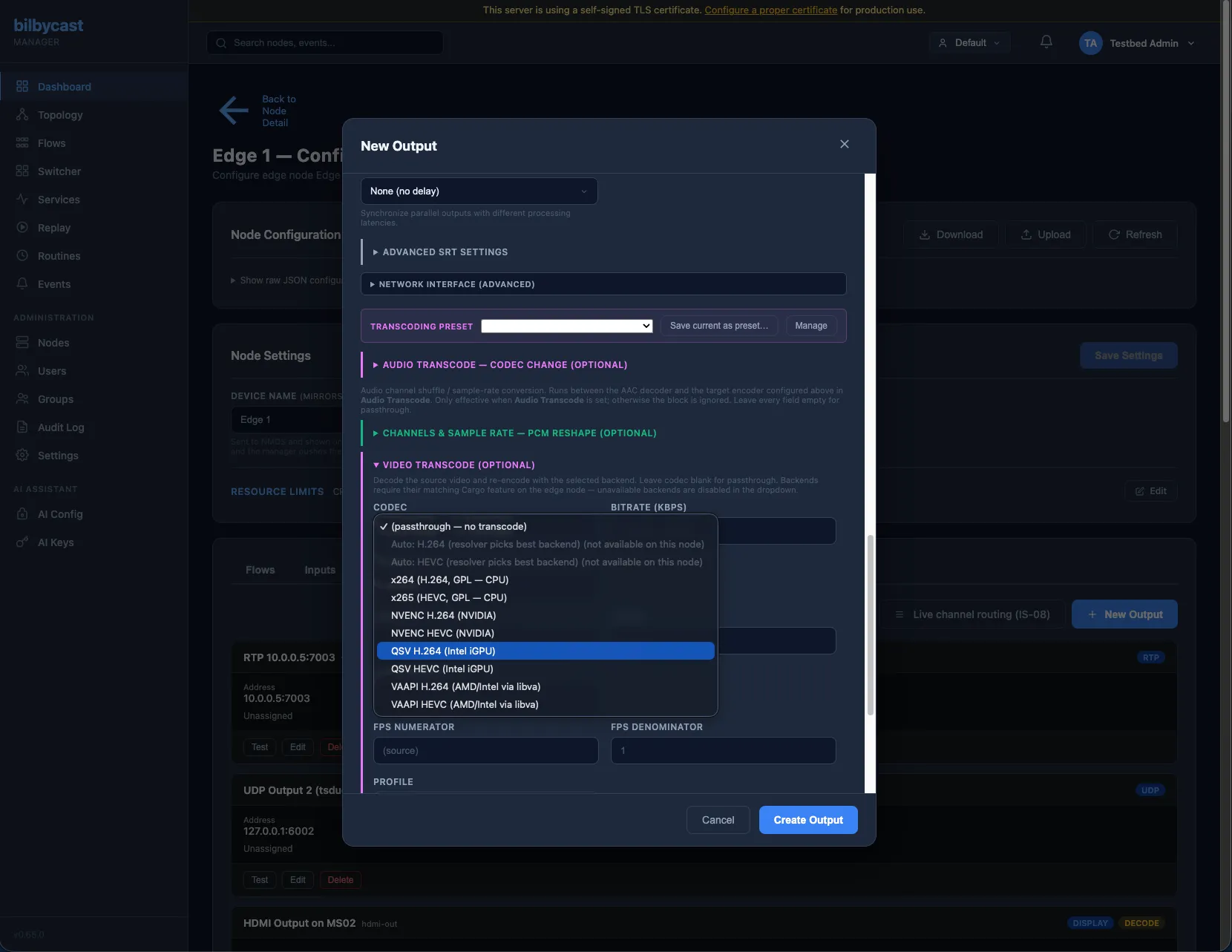
Supported encoders (opt-in via Cargo features):
| Feature | Codec | Runtime |
|---|---|---|
video-encoder-x264 |
H.264 via libx264 (GPL v2+) | CPU |
video-encoder-x265 |
HEVC via libx265 (GPL v2+) | CPU |
video-encoder-nvenc |
H.264 / HEVC via NVIDIA NVENC (LGPL-clean API, requires NVIDIA GPU + driver) | GPU |
video-encoder-qsv |
H.264 / HEVC via Intel QuickSync / oneVPL (LGPL-clean, x86_64 only) | iGPU |
video-encoder-vaapi |
H.264 / HEVC via VAAPI (libva MIT, Linux; AMD radeonsi / Intel iHD) | iGPU/dGPU |
video-decoder-nvdec |
NVIDIA NVDEC HW decode (h264_cuvid / hevc_cuvid) — display + transcode |
GPU |
video-decoder-qsv |
Intel QSV HW decode (h264_qsv / hevc_qsv, x86_64 only) — display + transcode |
iGPU |
video-decoder-vaapi |
VAAPI HW decode (h264_vaapi / hevc_vaapi, Linux) — display + transcode |
iGPU/dGPU |
video-encoder-rkmpp |
H.264 / HEVC via Rockchip RKMPP on RK3568 / RK3588 (8-bit 4:2:0 only) | VPU |
video-decoder-rkmpp |
Rockchip RKMPP HW decode — display + transcode | VPU |
video-encoders-full |
Bundle of every video codec backend — encoders (x264 + x265 + NVENC + QSV + VAAPI) + HW decoders (NVDEC + QSV + VAAPI). Used by the x86_64 *-full release artefact only; both aarch64 artefacts list their features individually |
— |
The release tarball (bilbycast-edge-$(uname -m)-linux-full.tar.gz) bundles libx264 + libx265 + NVENC + QSV + VAAPI (encode) and NVDEC + QSV-decode + VAAPI-decode (display HW playout + transcode decode) — the aarch64 build omits QSV in both directions because Intel iGPU is x86_64-only. Combined work is AGPL-3.0-or-later under the GPL portions; the runtime probe auto-detects which backends actually open on the host.
ST 2110-22 (JPEG XS) transcoding is deferred pending a libjxs wrapper. HLS video_encode is the last deferred transport — tracked in the repo’s transcoding.md.
Output Delay (path synchronisation)
Section titled “Output Delay (path synchronisation)”SRT, RIST, RTP, and UDP outputs accept an optional delay block so parallel paths with different processing latencies stay aligned. Three modes:
fixed— constant delay in milliseconds, applied at the outputtarget_ms— self-adjusting target end-to-end latency in millisecondstarget_frames— frame-accurate target latency using the auto-detected input frame rate, with optional ms fallback if the frame rate cannot be determined
Typical use case: a flow with a clean primary feed and a secondary feed that goes through an external loudness processor or captioning engine. Apply the right mode on the clean output to compensate for the extra latency on the processed path.
Seamless Input Switching
Section titled “Seamless Input Switching”Flows can be configured with multiple input_ids; only one is active at a time. Switching is driven by POST /api/v1/flows/{id}/activate-input and is zero-gap:
- A shared
TsContinuityFixer(per flow) with per-input PSI caching resets CC state on switch, creating a clean-break CC jump so receivers resync - The new input’s cached PAT/PMT is injected with its
version_numberstamped from a per-fixer monotonic counter (CRC32 recalculated) — the counter advances on every switch, including to dead inputs, so consecutive switches always produce a strictly-different version. A naivecached_version + 1stamping would emit identicalversion = 1phantoms for every input whose natural version is 0 (virtually every ffmpeg / srt-live-transmit / camera-SDK-generated stream) and leave receivers’ audio decoders locked on the previous input’s format after anA → B → Around-trip - All subsequent packets forward immediately — no buffering delay, no renegotiation
- A 250 ms-interval NULL-PID (0x1FFF) keepalive goes out whenever the active input has no packets to forward — keeps downstream UDP sockets and decoder state alive when the operator switches to an input whose source isn’t currently transmitting
The switcher is fully format-agnostic: inputs can use different codecs, containers, and transports. A flow can have H.264 SRT on one input, HEVC RIST on another, JPEG XS on a third, and uncompressed ST 2110-20 on a fourth, and cut between them with no visible gap on the output.
For non-TS transports (raw ST 2110 RTP audio or video), the fixer is transparent.
Monitoring and Analysis
Section titled “Monitoring and Analysis”TR-101290 Transport Stream Analysis
Section titled “TR-101290 Transport Stream Analysis”- Priority 1: Sync byte, continuity counter, PAT/PMT presence
- Priority 2: TEI, PCR discontinuity (
pcr_discontinuity_errorsnow strictly counts unsignalled PCR jumps — a forward leap over 100 ms, or any step backwards, on a packet whosediscontinuity_indicatoris clear), PCR accuracy — plus the extended checks: PCR repetition (a PCR-bearing PID silent for more than 100 ms, split out of the discontinuity counter), PTS repetition (a PES PID that has produced a PTS going quiet for more than 700 ms), and CAT presence - Priority 3: NIT, SDT, EIT, TDT, RST, SI-repetition, and Unreferenced_PID errors
- The P2-extended and P3 counters are summarised together as
priority3_okonTr101290Stats— omitted from the payload entirely by edges that predate them — and are advertised as thetr101290_fullcapability. The manager gates its extended TR 101 290 sub-panel on that bit, so an older edge keeps the Priority 1 + 2 surface it always had - Runs as independent broadcast subscriber (zero jitter impact)
- Skipped automatically for non-TS inputs (ST 2110-30/-31/-40,
rtp_audio, WebRTC)
MPEG-TS Program Analysis
Section titled “MPEG-TS Program Analysis”- Parses PAT and every PMT from the input broadcast channel
- Reports per-program stream breakdown in the manager UI: each program’s video PIDs (codec, resolution, frame rate, profile, level) and audio PIDs (codec, sample rate, channels, language)
- Handles PAT/PMT version bumps and programs coming/going mid-stream
program_countin stats reflects the number of programs advertised in the PAT
VSF TR-07 Awareness
Section titled “VSF TR-07 Awareness”- Auto-detects JPEG XS (stream type 0x61) in PMT
- Reports TR-07 compliance status via API and dashboard
- Enable with
tr07_mode: truein RTP input config
SMPTE Trust Boundary Metrics (RP 2129)
Section titled “SMPTE Trust Boundary Metrics (RP 2129)”- Inter-arrival time (IAT): min/max/avg per reporting window
- Packet delay variation (PDV/jitter): RFC 3550 exponential moving average
- Filtered PDV (CMAX): peak-to-peak filtered metric
- Source IP filtering (C5), payload type filtering (U4), rate limiting (C7)
- DSCP/QoS marking (C10)
- Per-flow bandwidth monitoring for trust boundary enforcement
- Flow health derivation (M6): Healthy/Warning/Error/Critical
Cargo Features
Section titled “Cargo Features”| Feature | Description | Default |
|---|---|---|
tls |
Enable RTMPS (RTMP over TLS) via rustls / tokio-rustls |
Yes |
webrtc |
Enable WebRTC WHIP/WHEP input and output via str0m |
Yes |
fdk-aac |
In-process AAC decode + encode via Fraunhofer FDK AAC (AAC-LC, HE-AAC v1/v2, multichannel up to 7.1). Replaces symphonia decode and the ffmpeg AAC encode subprocess | Yes |
media-codecs |
In-process video decode, JPEG thumbnail encode, uncompressed ST 2110-20/-23 video decode, and Opus / MP2 / AC-3 audio encode via FFmpeg libavcodec / libswscale / libopus. Eliminates all ffmpeg subprocess dependencies on the default build | Yes |
replay |
Continuous flow recording to disk + clip playback as a fresh input (variable-speed 0.1×–1.0×, frame-step, MP4 export, recordings library). Pure Rust, no new C deps | Yes |
display |
Local-display output (HDMI / DisplayPort via KMS + ALSA) for confidence-monitor playout. Linux-only effect | Yes |
video-encoder-x264 |
H.264 video transcoding via libx264. GPL v2+ — binaries with this feature are an AGPL-3.0-or-later combined work | No |
video-encoder-x265 |
HEVC video transcoding via libx265. GPL v2+ — same combined-work implications as x264 | No |
video-encoder-nvenc |
NVIDIA NVENC H.264 / HEVC hardware encoders. LGPL-clean API layer; requires an NVIDIA GPU + proprietary driver at runtime | No |
video-encoder-qsv |
Intel QuickSync H.264 / HEVC encoders via oneVPL. LGPL-clean; x86_64 only; needs Intel iGPU + media driver | No |
video-encoder-vaapi |
VAAPI H.264 / HEVC encoders (Linux). Royalty-free (libva MIT); AMD radeonsi / Intel iHD; needs libva-dev + working VAAPI driver |
No |
video-decoder-nvdec |
NVIDIA NVDEC hardware decode (display output + transcode decode path). Shares nv-codec-headers with video-encoder-nvenc |
No |
video-decoder-qsv |
Intel QSV hardware decode (display output + transcode decode path). Shares libvpl-dev with video-encoder-qsv; x86_64 only |
No |
video-decoder-vaapi |
VAAPI hardware decode (display output + transcode decode path). Shares libva-dev with video-encoder-vaapi; Linux |
No |
video-encoders-full |
Composite of every video codec backend the edge knows about — encoders (x264 + x265 + NVENC + QSV + VAAPI) and HW decoders (NVDEC + QSV-decode + VAAPI-decode). Used by the x86_64-linux-full release artefact only — both aarch64 artefacts enumerate their features individually and never pull in this composite |
No |
video-encoder-rkmpp |
Rockchip RK3568 / RK3588 hardware H.264 / HEVC encode via RKMPP (8-bit 4:2:0 only; x264 / x265 cover 10-bit and 4:2:2). Links dynamically against librockchip_mpp |
No (on in aarch64-linux-rockchip) |
video-decoder-rkmpp |
Rockchip RKMPP hardware decode — shared by the local-display output and the transcode decode path | No (on in aarch64-linux-rockchip) |
rga-transfer |
Rockchip RGA-accelerated DRM_PRIME→sysmem frame transfer on the local-display path, replacing FFmpeg’s CPU mmap+memcpy (~3 ms/frame vs ~106 ms spikes at 1080p on RK3588). Implies video-decoder-rkmpp; needs /dev/rga at run time |
No (on in aarch64-linux-rockchip) |
multiviewer |
Mosaic compositor + stream head — composites N node-local inputs onto one canvas and republishes it as MPEG-TS, so a multiviewer wall is an ordinary flow source (type: "mosaic"). Implies media-codecs, and needs a video-encoder-* feature to be usable: the flow bus carries TS, so a canvas reaches an output only by being encoded and muxed. The mv-compositor capability is advertised only when both halves are present. See Multiviewer |
No (on in all three release artefacts) |
mxl |
MXL (Media eXchange Layer) — EBU / Linux Foundation same-host shared-memory composition. Heavy build prerequisites, dlopens libmxl.so at run time. See MXL |
No (on in all three release artefacts) |
mxl-not-built |
Sub-toggle of mxl: skip the upstream libmxl C++ cmake build, emitting only the dlopen FFI from the vendored headers. The binary still loads libmxl.so at run time, so the heavy build chain is not needed on the release runner. See MXL |
No (on in all three release artefacts) |
sdi-decklink |
SDI capture + playout on Blackmagic DeckLink cards (type: "sdi"). Build needs the EULA-gated DeckLink SDK headers, which is why it is not folded into video-encoders-full. See SDI |
No (on in both *-linux-full artefacts from v0.103.0; never in *-rockchip) |
hardware-monitor-nvml |
Live NVIDIA NVENC / NVDEC utilisation sampling via nvml-wrapper, feeding the manager’s resource-budget UI. The dependency is target-conditional (Linux + Windows only), so a generic cargo build stays portable without it. See Resources |
No |
ptp-internal |
Reserved for an in-process PTP slave clock via the pure-Rust statime crate, for single-process deployments that would rather not run ptp4l. Currently a no-op marker — the flag builds and is advertised, but the reporter still falls back to ptp4l. See ST 2110 |
No |
The Default column above says what a plain cargo build does; the parenthetical says what the published release artefacts carry, which is the answer that matters if you are running a downloaded binary rather than one you built. Confirm either with bilbycast-edge --print-capabilities, which prints one feature <name> line per compiled-in feature.
The release tarball bundles GPL / NVENC encoders — see bilbycast-edge/docs/transcoding.md in the repo for the full licence breakdown.
Architecture Notes
Section titled “Architecture Notes”- All outputs subscribe to a shared broadcast channel independently
- Slow outputs receive
Laggederrors and drop packets — they never block the input or other outputs - TCP-based outputs (RTMP, HLS) use an mpsc bridge pattern to keep TCP operations off the broadcast receive path
- All monitoring (TR-101290, IAT/PDV, TR-07) runs on independent analyzer tasks with zero impact on the data plane