
Security
Architecture Overview
Section titled “Architecture Overview”bilbycast-manager handles several categories of sensitive data:
- User passwords — hashed with Argon2id, never stored in plaintext
- JWT session tokens — signed with HMAC-SHA256 using
BILBYCAST_JWT_SECRET - Node secrets — encrypted at rest with authenticated envelope encryption
- AI API keys — encrypted at rest with authenticated envelope encryption
- Tunnel keys — encrypted at rest, never exposed to the relay
- Service secrets — the passphrases, keys and stream-id credentials a wizard-built service provisions: encrypted at rest, and
[REDACTED]in every read of the service - Configuration — non-secret settings stored in plaintext TOML
All cryptographic secrets are loaded from environment variables at startup. The server refuses to start if secrets are missing, empty, too short (under 64 hex characters / 32 bytes), or contain known weak/default values.
Full cryptographic design details — key derivation, domain separation, envelope formats, backup file layout — are provided to commercial licensees under NDA.
Secrets Management
Section titled “Secrets Management”Environment Variables
Section titled “Environment Variables”Two secrets are required and must be set before starting the server:
| Variable | Purpose |
|---|---|
BILBYCAST_JWT_SECRET |
HMAC key for signing/verifying JWT session tokens |
BILBYCAST_MASTER_KEY |
Root secret from which per-domain encryption keys are derived |
Generate them with:
openssl rand -hex 32These must never appear in config/default.toml or be committed to version control.
Stored Secrets Encryption
Section titled “Stored Secrets Encryption”All stored secrets (node credentials, tunnel keys, AI provider keys, MFA material) are encrypted with authenticated encryption using per-domain keys derived from the master secret. Each secret is wrapped with its own per-record data key so compromise of any individual record does not affect others. Different classes of secret use distinct derived keys so a breach in one domain cannot decrypt another. Ciphertexts carry a version prefix so the format can evolve without breaking existing deployments.
Master Key Rotation
Section titled “Master Key Rotation”The master encryption key can be rotated via the CLI without data loss:
BILBYCAST_NEW_MASTER_KEY=$(openssl rand -hex 32) bilbycast-manager rotate-master-keyThis re-encrypts all secrets in the database under the new key in a single atomic transaction. The server must be stopped during rotation.
.env File Permissions
Section titled “.env File Permissions”The .env file contains the master secrets and should be restricted:
chmod 600 .envEnsure it is listed in .gitignore.
User Authentication
Section titled “User Authentication”Password Hashing
Section titled “Password Hashing”User passwords are hashed with Argon2id. Plaintext passwords are never stored or logged.
Password requirements:
- Minimum 8 characters, maximum 128 characters
- Must contain at least one uppercase letter, one lowercase letter, and one digit
Self-Service Password Change
Section titled “Self-Service Password Change”Authenticated users can change their own password via the “My Account” page. The endpoint verifies the current password before accepting the new one, re-runs the complexity rules, and re-issues a fresh session cookie so the caller stays signed in. Changing a password instantly signs the user out of every other browser session.
Per-Account Login Lockout
Section titled “Per-Account Login Lockout”In addition to the per-IP rate limiter, each user account has its own failed-login counter: 5 consecutive failed password attempts trigger a 15-minute lockout. While locked, login is rejected with identical response timing to a normal failure, so the lock status is not observable to attackers.
Both numbers are compile-time constants. The Max Login Attempts field under Settings → Security is stored and range-validated but read by nothing, so editing it does not move the lockout threshold.
JWT Session Tokens
Section titled “JWT Session Tokens”After successful login, the server issues a JWT signed with HMAC-SHA256. The token is delivered exclusively via an HttpOnly; Secure; SameSite=Lax cookie — never in the response body. A separate non-httpOnly csrf_token cookie is set alongside it for CSRF protection.
Every session token is minted with a fixed 24-hour expiry — local login, MFA completion and SSO callback alike. The Session Lifetime (hours) field under Settings → Security is likewise stored and validated but not yet read, so changing it neither shortens nor extends a session.
Session Revocation
Section titled “Session Revocation”Logout invalidates the session server-side so revoked tokens are rejected on every subsequent request even before their natural expiration.
Login Rate Limiting
Section titled “Login Rate Limiting”Login attempts are rate-limited per client IP address: 5 attempts within a 60-second window, then HTTP 429 until the window resets.
Role-Based Access Control (RBAC)
Section titled “Role-Based Access Control (RBAC)”Access control uses two orthogonal axes. A platform-level role distinguishes the platform operator (super_admin) — who bypasses every group filter and is the only role allowed to touch platform-only chokepoints (group management, TLS, SSO, licensing, backup export/import, master-key rotation) — from every other account (user), whose authority flows entirely from per-group memberships.
Per-group permissions are granted in ascending order:
| Role | Level | Typical Permissions |
|---|---|---|
viewer |
0 | Read-only access to dashboards and node status |
operator |
1 | Start/stop flows, acknowledge events |
admin |
2 | Create/delete nodes and users, manage settings |
A user can hold different per-group roles in different groups (Admin in one, Viewer in another).
Per-command roles. The table above is a floor, not a ceiling. Each device driver declares a minimum role for every command it accepts, and POST /api/v1/nodes/{id}/command enforces that on top of the per-node operator check every command already has to pass. A declaration of viewer or operator therefore adds nothing — that baseline check is still the only gate. Any other value, including one the manager does not recognise, is read as admin on that node, and a caller without it is refused with HTTP 403, error_code: "insufficient_role" and required_role: "manage" — the refusal body spells the three levels view / operate / manage, which are the same ladder as viewer / operator / admin above. A command the driver does not list keeps the operator baseline, because those tables are introspection metadata rather than an allowlist.
In practice a group Operator can start and stop flows but cannot invoke the commands a driver marks admin-only — authorize_tunnel and revoke_tunnel on a relay (which govern bind authentication) or configure_distribution (which sets the viewer-token secret) — all three declared admin by the relay driver. The declared minimum for every command is published on GET /api/v1/device-types as supported_commands[].requires_role.
Temporary Users
Section titled “Temporary Users”Users can be marked as temporary with an expires_at timestamp. Expired accounts are denied access at permission check time.
CSRF Protection
Section titled “CSRF Protection”CSRF tokens are 128 bits of randomness and compared in constant time. State-changing requests must include an X-CSRF-Token header matching the csrf_token cookie that is set at login.
Username Enumeration Protection
Section titled “Username Enumeration Protection”The login endpoint always runs an Argon2id verification (against a dummy hash when the user doesn’t exist) to equalize response timing, preventing attackers from discovering valid usernames via timing differences.
Multi-Factor Authentication (TOTP)
Section titled “Multi-Factor Authentication (TOTP)”Users can enroll a TOTP (RFC 6238) second factor compatible with any authenticator app. TOTP is implemented in pure Rust — no C dependencies.
Enrollment is a two-step flow: generate a fresh secret and scan the QR code, then confirm with a 6-digit code to finalise. On success the server returns 10 single-use recovery codes, shown exactly once; only hashes are persisted.
When an MFA-enrolled user signs in with password, the server returns a short-lived challenge token rather than a session. The client completes login by posting the challenge plus a TOTP (or recovery) code. Per-user TOTP verification is rate-limited independently of the IP-based login limiter.
Disabling MFA requires both the current password and a valid TOTP (or recovery code), so neither a stolen cookie alone nor a stolen password alone can turn it off.
When a user logs in via OIDC SSO, the IdP is responsible for enforcing MFA — the bilbycast TOTP step is skipped.
Single Sign-On (OIDC)
Section titled “Single Sign-On (OIDC)”bilbycast-manager supports SSO via OpenID Connect Authorization Code flow with PKCE. Verified against Keycloak, Authentik, Okta, Auth0, Azure AD, and Google Workspace. Local password login continues to work alongside SSO (hybrid mode) so admins always have a break-glass path.
SSO is a licensed feature. A valid SSO configuration without an SSO-granting license logs a warning and disables SSO without failing startup, so a license downgrade cannot brick the server.
The flow is:
- User clicks Sign in with SSO on
/login(only rendered when SSO is enabled on the server). - The manager starts a PKCE-protected OIDC flow with the configured IdP.
- On callback, the ID token is fully validated (signature, issuer, audience, expiration, nonce).
- Strict provisioning — the manager does not auto-create users from SSO. An admin must pre-create a local user whose email matches the IdP’s verified email claim; the first SSO login binds the IdP identity to that user row.
- On success, the same session cookie + CSRF cookie used by local login are issued.
Optional role sync maps IdP group claims onto local roles — but only when the IdP actually sends a non-empty group claim. Removing a user from every IdP group sends an empty (or absent) claim, which skips the sync entirely: the user keeps the platform role and every manager group membership they already had. Revoke access by deactivating or deleting the local user, or by moving them into a mapped lower-privilege group — not by removing them from their IdP groups.
License and Paid Features
Section titled “License and Paid Features”The manager has a signed-license model used for both hard limits (maximum node count) and for enabling optional paid features (such as SSO and Encrypted Backup & Restore). Licenses are cryptographically signed; the manager detects and refuses tampered or forged tokens. License state is refreshed periodically so a license that expires while the server is running takes effect automatically.
Gated endpoints return machine-readable errors that the UI uses to render a uniform upgrade banner. Rotating or removing a license never bricks a running install.
Signing-key handling, token format, and tamper-detection mechanics are intentionally not documented publicly.
Encrypted Backups
Section titled “Encrypted Backups”Encrypted backup and restore is available under the backup commercial feature.
- Broad, but not total. Fifty-two persisted tables round-trip — users, nodes, tunnels, managed flows, AI provider keys, settings, audit logs, events, topology positions and UI preferences, plus master graphs, address pools, multiviewer, replay and DVR. Sixteen live tables are carried by neither the export nor the restore, among them the whole Services feature, switcher preset actions, managed inputs and outputs, and AI conversations; personal API tokens are deliberately left out and cleared on restore; Encrypted Backup & Restore lists them table by table.
- Cross-machine portable. Secrets are unsealed on the source and resealed on the destination so the backup file is bound only to the operator-supplied passphrase, not to any one machine.
- Confidential at rest. Sealed with authenticated encryption and a memory-hard key derivation function applied to the operator-supplied passphrase. Passphrases must be at least 12 characters; lost passphrases mean lost data.
- Safe restore. Runs in a single atomic transaction — any failure leaves the destination untouched. The REST import (
POST /api/v1/import) refuses a populated destination unless the request opts in withforce; thebilbycast-manager importCLI always overwrites, gated on a typedYESconfirmation at the terminal instead.
Ephemeral runtime state (sessions, PTP cache, OIDC login state, etc.) is intentionally never exported.
Operators can export / restore from /admin/settings in the UI or via the bilbycast-manager export / import CLI commands.
Node Authentication
Section titled “Node Authentication”Two-Stage Registration
Section titled “Two-Stage Registration”Managed devices (edge nodes, relay servers, API gateways) authenticate using a two-stage process:
- Registration: The administrator creates a node entry, which generates a one-time registration token. The device presents the token on
/ws/nodeand receives a permanent identifier + secret. - Reconnection: On subsequent connections, the device presents its stored identifier and secret.
Credentials are sent inside the authenticated WebSocket channel, never in URL query parameters. Failed attempts are rate-limited per identifier and node secrets are encrypted at rest. Registration tokens are never stored in plaintext.
Transport Security
Section titled “Transport Security”TLS (HTTPS/WSS)
Section titled “TLS (HTTPS/WSS)”The manager supports two TLS modes:
Direct Mode (default)
Section titled “Direct Mode (default)”The manager handles TLS itself via rustls (pure Rust). Requires a TLS certificate and private key (BILBYCAST_TLS_CERT / BILBYCAST_TLS_KEY). Cookies include the Secure flag and HSTS headers are sent on all responses.
Behind Proxy Mode
Section titled “Behind Proxy Mode”A load balancer terminates TLS in front of the manager. The manager listens on plain HTTP/WS. Cookies do not include the Secure flag and HSTS is not sent (the LB is expected to provide them). The LB-to-manager link must be on a trusted network.
Self-Signed Certificate Detection
Section titled “Self-Signed Certificate Detection”At startup, the manager detects self-signed certificates and surfaces a warning banner in the UI and in the /health endpoint.
Certificate Management
Section titled “Certificate Management”Three methods are available, from most to least recommended:
- ACME / Let’s Encrypt — automatic provisioning and renewal. Private keys generated on-server using ECDSA P-256 and never transmitted. HTTP-01 challenge on port 80. Certificates hot-reload without restart.
- File-based (certbot) — manual management via
BILBYCAST_TLS_CERT/BILBYCAST_TLS_KEY. - Behind proxy — LB terminates TLS; no certificates needed on the manager.
Edge and Relay Node Connections
Section titled “Edge and Relay Node Connections”Edge and relay nodes must connect using wss:// URLs. Both clients enforce this and reject plaintext ws:// URLs.
Self-Signed Certificate Acceptance (Development)
Section titled “Self-Signed Certificate Acceptance (Development)”Edge and relay nodes can accept self-signed TLS certificates by setting accept_self_signed_cert: true in their config. This should only be used for development — it disables certificate validation.
API Security
Section titled “API Security”- Authentication: All authenticated API endpoints require a valid JWT session cookie. Bearer tokens accepted as an alternative. State-changing requests require a matching CSRF header.
- UI page protection: Unauthenticated requests are redirected to
/login?next=<path>, withnextstrictly validated to prevent open redirects. - WebSockets:
/ws/nodeuses the two-stage node protocol;/ws/dashboardrequires a valid session before upgrade. - Security headers:
X-Content-Type-Options: nosniff,X-Frame-Options: DENY, 2-year HSTS (max-age=63072000; includeSubDomains; preload, direct TLS mode only — behind a proxy the load balancer owns it), and an enforcingContent-Security-Policy—default-src 'self'; script-src 'self'; style-src 'self' 'unsafe-inline'; img-src 'self' data: blob:; font-src 'self' data:; connect-src 'self'; frame-ancestors 'none'; form-action 'self'; base-uri 'self'; report-uri /api/v1/csp-report— that trailing directive is what posts violations to the built-in collector.script-src 'self'with nounsafe-inlineis what blocks inline event handlers, the execution vector every known injection path in this UI relies on; it is defence in depth behind correct escaping at the sink, not a substitute for it.style-src 'unsafe-inline'is still permitted, because the pages ship inline<style>blocks — that migration is separate. - CORS: same-origin only.
- Tunnel confidentiality: end-to-end authenticated encryption between edge nodes. The relay never sees plaintext.
- Registration token protection: the
registration_tokenfield is excluded from all node API responses.
AI Assistant
Section titled “AI Assistant”AI provider API keys — personal and organisation — are encrypted at rest with authenticated envelope encryption, never returned by the API, and decrypted only when needed to call the provider. Conversations and the body of each proposal are encrypted at rest — a proposal’s title, which the model writes, is stored in plain text and is not redacted — and personal API tokens for AI agents are stored only as hashes.
The assistant sends the operator’s messages and the results of the tools it runs to the model provider the organisation allows, with every secret value redacted first; it can change nothing until one of its proposals is applied — by a person, or by an external agent its owner has given an apply-scoped token — and an apply runs through the same routes, permissions and audit trail as the UI. The full data-flow and credential model is on the AI Assistant page.
Audit Log
Section titled “Audit Log”Every state-changing operator action is recorded in a group-scoped audit table — timestamp, user, action name, target entity, and a structured details payload with the parameters. Visible at /admin/audit-log to admins of the owning group, and to SuperAdmins across all groups.
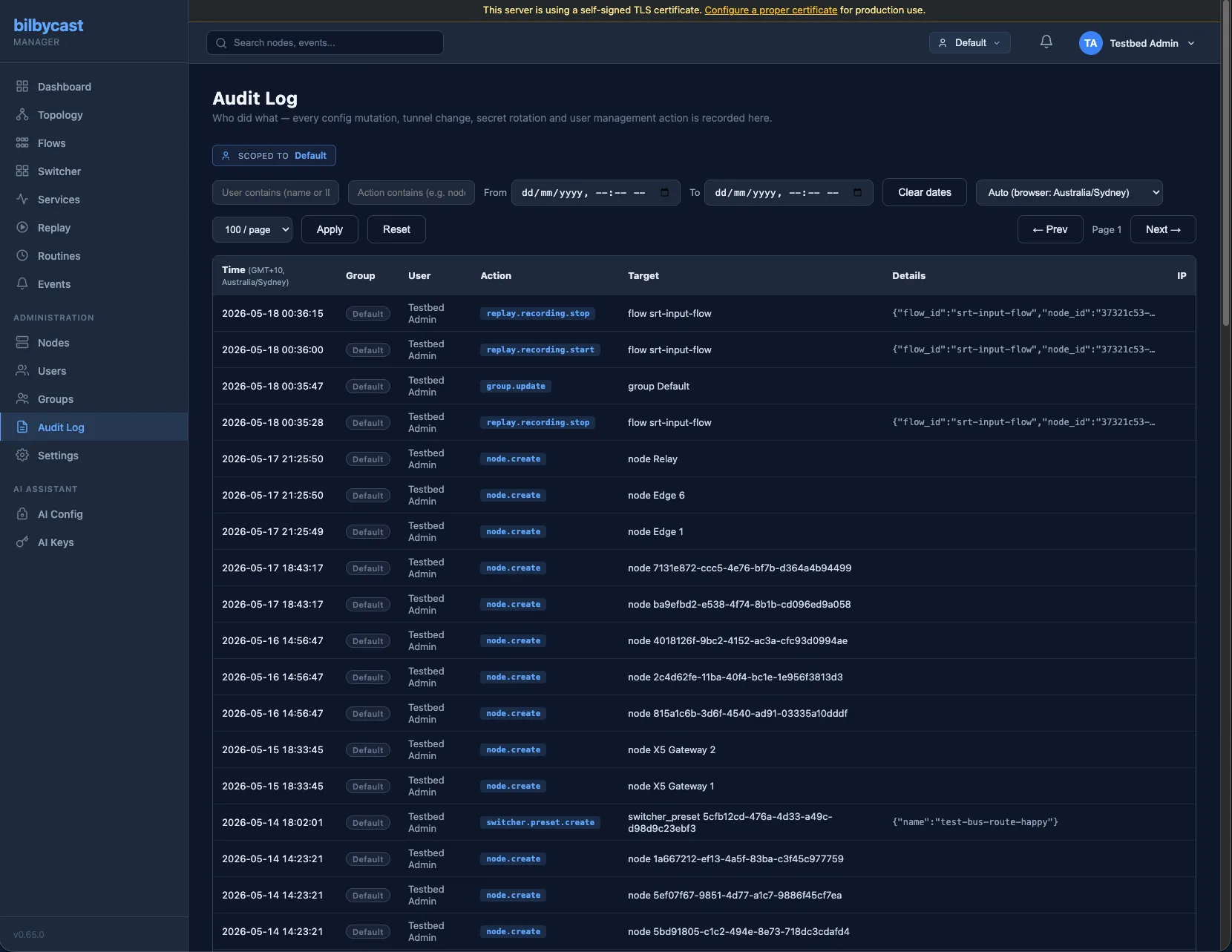
Coverage:
- Switcher —
switcher.preset.activate,switcher.take,switcher.pvw.{set,clear},switcher.preset.{create,update,delete},switcher.page.{create,update,delete}. - Node CRUD — node create, edit, delete, secret rotation, registration token regeneration.
- Flows / inputs / outputs — create, update, delete, hot input add/remove, recording arm/disarm.
- Routines — fire (manual + scheduled), partial / failed / missed transitions.
- AI-driven changes — every step of an applied AI proposal writes its route’s own audit row, plus one
ai.proposal.applyrow naming the proposal, the conversation, the steps and the outcome; provider keys, the AI policy and personal API tokens are audited as they change. - Auth events — login success / failure, MFA enrollment, OIDC binding, password change, lockouts.
The log is append-only at the data layer — no API path deletes rows. Retention is configurable per deployment.
What Is NOT Yet Implemented
Section titled “What Is NOT Yet Implemented”- WebAuthn / passkey support — only TOTP is available today.
- Mutual TLS (mTLS) for node authentication — nodes authenticate via WebSocket message, not client certificates.
- Hardware Security Module (HSM) support — master keys are stored in environment variables.
- Audit log signing — events are logged but not cryptographically signed.
- IP allowlisting for node connections.
- API rate limiting on authenticated endpoints.
- SAML SSO — only OIDC is supported.
Recommendations for Production Deployment
Section titled “Recommendations for Production Deployment”- Provide TLS certificates — TLS is mandatory. Use ACME or CA-signed certificates for production.
- Restrict
.envpermissions —chmod 600 .env. - Use a reverse proxy — for request size limits and IP filtering.
- Rotate secrets periodically —
bilbycast-manager rotate-master-keyhandles master-key rotation without data loss. - Back up regularly — use the built-in encrypted backup (if licensed) to produce portable, passphrase-sealed snapshots.
- Monitor logs — watch for repeated authentication failures.
- Run as a non-root user — create a dedicated service account with minimal filesystem permissions.