
Events & Alarms
bilbycast-edge generates operational events and forwards them to bilbycast-manager via WebSocket. Events provide real-time visibility into connection state changes, failures, and significant operational conditions that go beyond periodic stats and health messages.
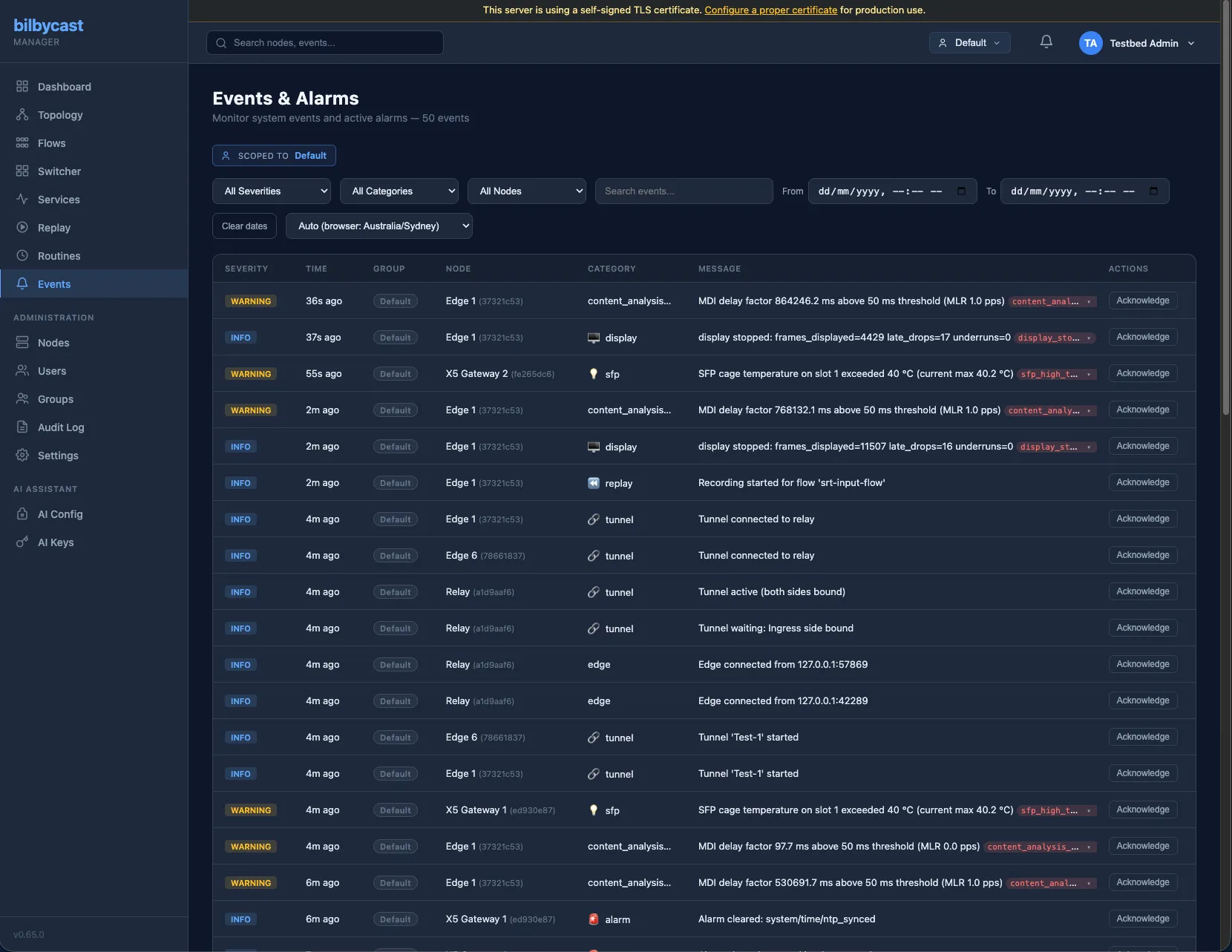
Event Protocol
Section titled “Event Protocol”Events are sent as WebSocket messages with type "event":
{ "type": "event", "timestamp": "2026-04-02T12:00:00Z", "payload": { "severity": "warning", "category": "srt", "message": "SRT input disconnected, reconnecting", "flow_id": "flow-1", "input_id": "input-1", "details": { ... } }}Severity Levels
Section titled “Severity Levels”| Severity | Meaning | Action |
|---|---|---|
critical |
Service-impacting failure | Operator should investigate immediately |
warning |
Degradation or potential issue | Operator should investigate when possible |
info |
Notable state change | No action required, operational awareness |
Event Fields
Section titled “Event Fields”| Field | Type | Required | Description |
|---|---|---|---|
severity |
string | yes | "info", "warning", or "critical" |
category |
string | yes | Event category (see tables below) |
message |
string | yes | Human-readable description |
flow_id |
string | no | Associated flow or tunnel ID |
input_id |
string | no | Input the event is attributed to — a top-level key, sibling of flow_id |
output_id |
string | no | Output the event is attributed to — a top-level key, sibling of flow_id, and distinct from the details.output_id that display and SRT events also carry |
details |
object | no | Structured context (error codes, peer addresses, etc.) |
Deduplication
Section titled “Deduplication”Events are emitted on state transitions, not periodically. For example, an SRT disconnect event fires once when the connection drops, not repeatedly while disconnected. The corresponding reconnection event fires when the connection is restored.
For protocols with automatic reconnection loops (RTSP, SRT caller), disconnect events fire once per connection cycle — if the remote is unreachable and retries continue, subsequent retry failures are silent until a connection succeeds and then drops again.
Buffering
Section titled “Buffering”Events are queued in a bounded in-memory channel of 4096 slots (EVENT_CHANNEL_CAPACITY), drained only while a manager session is up. When the edge is not connected to the manager (e.g., during reconnection), events accumulate up to that cap and are delivered once the connection is re-established.
Past 4096 the send is non-blocking and the newest event is discarded — the queued backlog is preserved, the arriving event is not. The only record is a tracing::warn! on the node, rate-limited to one per second, carrying the interval and lifetime drop counts and the capacity; nothing is re-queued and nothing reaches the manager, so a long outage or a sustained error storm loses events silently from the manager’s point of view. When the structured-JSON log shipper is configured it is fed before the channel send, so a SIEM / NMS still receives events the manager channel drops.
Event Reference
Section titled “Event Reference”Flow Lifecycle (flow)
Section titled “Flow Lifecycle (flow)”| Severity | Message | Trigger |
|---|---|---|
| info | Flow ‘{id}’ started | Flow successfully created and running |
| info | Flow ‘{id}’ stopped | Flow stopped by command or config change |
| critical | Flow ‘{id}’ failed to start: {error} | Flow startup error (input bind, output bind, validation) |
| critical | Flow input lost: {error} | Input task exited unexpectedly |
| info | Output ‘{id}’ added to flow ‘{flow_id}’ | Hot-add output succeeded |
| info | Output ‘{id}’ removed from flow ‘{flow_id}’ | Hot-remove output succeeded |
| warning | Output ‘{id}’ failed to start on flow ‘{flow_id}’: {error} | Output startup failure within a running flow |
Source: src/engine/manager.rs, src/engine/input_srt.rs
A/V quality & source clock (flow)
Section titled “A/V quality & source clock (flow)”The A/V quality watcher and the PCR-ingress sampler both file under flow. The discontinuity events describe the incoming stream — a source change, a looping file wrapping, a splicer stepping the clock — not a fault in the edge; each is debounced so a churning source can’t flood the feed.
| Severity | details.error_code |
Trigger |
|---|---|---|
| warning | av_skew_exceeded |
Edge-added A/V skew (FlowStats.av_skew) exceeded the EBU R37 ±40 ms limit for two consecutive 5 s polls. The configured lipsync trim counts toward the skew. |
| info | av_skew_recovered |
Skew back under 30 ms (hysteresis). |
| warning | av_interleave_deep |
Windowed p95 of OutputStats.av_interleave exceeded 1200 ms. Not a lip-sync fault — guidance that players caching ~1 s (VLC) will starve their audio queue on this stream. |
| info | av_interleave_recovered |
Windowed p95 back under 900 ms. |
| warning | source_pcr_discontinuity |
Source PCR jumped by > 500 ms in either direction. |
| warning | source_pts_discontinuity |
A per-PID PES PTS jumped by > 500 ms in either direction — forward and backward alike, same as PCR. |
| warning | source_dts_discontinuity |
A per-PID PES DTS jumped by > 500 ms in either direction (video reorder streams). |
Source: src/engine/av_quality_watch.rs, src/engine/pcr_ingress_sampler.rs
Media Player Input (flow)
Section titled “Media Player Input (flow)”| Severity | details.error_code |
Trigger |
|---|---|---|
| info | media_player_transition_started |
An operator Next was accepted and the cut is about to commit (details.trigger is always operator_next). Emitted by the controller path only; a natural end-of-source or loop wrap commits silently, and the legacy sequential loop emits nothing at all. |
| info | media_player_transition_completed |
That operator-Next cut committed — the new source is on air and generation has incremented. Not emitted for a natural or loop-wrap boundary. |
| warning | media_player_next_prepare_failed |
The Next target could not be opened, so the request was rejected. The player stays on the current source rather than cutting to dead air. |
| warning | media_player_pacer_lagging |
The ts / mp4 playout pacer fell ≥ 250 ms behind its own schedule — a source whose instantaneous packet rate exceeds what the bounded hand-off queue can absorb. Latched; fires once per episode. |
| info | media_player_pacer_recovered |
Lateness dropped back to ≤ 100 ms, clearing the latch. |
Source: src/engine/input_media_player.rs
The flow category additionally carries the PES-splice family (pes_splice_completed / _degraded / _timeout / pes_splice_codec_param_mismatch, plus splice_override_ignored) and the MXL input / output lifecycle. MXL’s failure identifiers ride the message text of the flow-failure event, not details.error_code, so alarm rules cannot match on them. Both families are catalogued in the in-repo docs/events-and-alarms.md.
Bandwidth (bandwidth)
Section titled “Bandwidth (bandwidth)”| Severity | Message | Trigger | Details |
|---|---|---|---|
| warning | Flow ‘{id}’ bandwidth exceeded limit ({current} Mbps > {limit} Mbps) | Input bitrate exceeds configured bandwidth_limit.max_bitrate_mbps for the grace period (alarm action) |
{ current_mbps, limit_mbps, action: "alarm" } |
| critical | Flow ‘{id}’ blocked: bandwidth exceeded limit ({current} Mbps > {limit} Mbps) | Input bitrate exceeds configured limit for the grace period (block action) — packets dropped until bandwidth normalizes | { current_mbps, limit_mbps, action: "block" } |
| info | Flow ‘{id}’ bandwidth returned to normal, unblocked | Bitrate returned within limits after being blocked — flow resumes | { current_mbps, limit_mbps } |
| info | Flow ‘{id}’ bandwidth returned to normal ({current} Mbps <= {limit} Mbps) | Bitrate returned within limits after alarm | { current_mbps, limit_mbps } |
Source: src/engine/bandwidth_monitor.rs
SRT (srt)
Section titled “SRT (srt)”SRT Input
Section titled “SRT Input”| Severity | Message | Trigger |
|---|---|---|
| info | SRT input connected (mode=listener) | Listener accepted a caller connection |
| info | SRT input connected (mode={mode}) | Caller connected to remote |
| info | SRT input connected (mode=listener, redundant leg 1) | Redundant leg 1 accepted |
| warning | SRT input disconnected, reconnecting | Peer disconnected, reconnection in progress |
| critical | SRT input connection failed: {error} | Listener accept or caller connect failed |
SRT Output
Section titled “SRT Output”| Severity | Message | Trigger |
|---|---|---|
| info | SRT output ‘{id}’ connected | Peer connected (listener) or caller connected |
| warning | SRT output ‘{id}’ disconnected | Peer disconnected or connection lost |
| warning | SRT output ‘{id}’ stale connection detected | No ACK received after timeout, re-accepting |
| critical | SRT output ‘{id}’ connection failed: {error} | Caller can’t reach remote, or bind fails |
Two SRT events carry a structured details.error_code:
| Severity | details.error_code |
Trigger | Details payload |
|---|---|---|---|
| critical | srt_output_peer_unreachable |
Caller mode: consecutive connect failures crossed the threshold (then every 20th attempt, ~10 min apart, so a long outage leaves a trail without flooding the feed). The output keeps retrying. | { error_code, output_id, remote_addr, attempts, error } |
| critical | srt_strict_binding_unsupported |
interface_binding.strict: true was requested on an SRT or RIST surface (input, output, or a bonding endpoint) — a Phase 1 limitation. Start is aborted. Use strict: false (loose source-IP binding), or pin the interface via a UDP-based protocol. The offending surface is named in the message text, not in the details — the payload carries nothing but the code. |
{ error_code } |
Source: src/engine/input_srt.rs, src/engine/output_srt.rs
SMPTE 2022-7 Redundancy (redundancy)
Section titled “SMPTE 2022-7 Redundancy (redundancy)”| Severity | Message | Trigger |
|---|---|---|
| warning | Redundant leg 1 lost | SRT redundant leg 1 stopped receiving |
| warning | Redundant leg 2 lost | SRT redundant leg 2 stopped receiving |
| critical | Both redundant legs lost | No data from either leg, will reconnect |
Two redundancy events carry a structured details.error_code:
| Severity | details.error_code |
Trigger | Details payload |
|---|---|---|---|
| warning | redundancy_failover_mode |
SRT redundancy landed on raw TS, which has no shared cross-leg sequence — the input runs active-leg failover, not hitless 2022-7 dedup. Configure the publisher to send RTP/TS (SMPTE ST 2022-2) for true hitless behaviour. | { error_code, format, fix_hint } |
| warning | redundancy_ssrc_mismatch |
The two RTP legs carry different SSRCs; 2022-7 needs byte-identical RTP including SSRC. | { error_code, mismatch_count } |
Source: src/engine/input_srt.rs, src/engine/input_rtp.rs
RTMP (rtmp)
Section titled “RTMP (rtmp)”| Severity | Message | Trigger |
|---|---|---|
| info | RTMP publisher connected | Client connected and started publishing |
| warning | RTMP publisher disconnected | Publisher disconnected |
| critical | RTMP server error: {error} | Server bind or accept failure |
Source: src/engine/input_rtmp.rs
RTSP (rtsp)
Section titled “RTSP (rtsp)”| Severity | Message | Trigger |
|---|---|---|
| info | RTSP connected to {url} | RTSP DESCRIBE/SETUP/PLAY succeeded |
| warning | RTSP input disconnected: {error}. Reconnecting in {n}s | Stream lost after a successful connection |
The disconnect event fires once per connection cycle — if the RTSP server is unreachable and the edge retries repeatedly, only the first failure emits an event. A new “connected” event followed by a new “disconnected” event will fire when the connection is established and then lost again.
Source: src/engine/input_rtsp.rs
HLS (hls)
Section titled “HLS (hls)”| Severity | Message | Trigger |
|---|---|---|
| warning | HLS segment upload failed: {error} | HTTP PUT fails for a segment |
| critical | HLS output failed: {error} | Output task exited with error |
Source: src/engine/output_hls.rs
CMAF / CMAF-LL (cmaf)
Section titled “CMAF / CMAF-LL (cmaf)”CMAF and low-latency CMAF output lifecycle plus manifest / segment upload failures. Only the init-segment upload and the thumbnail capture are latched to one event per output; the segment, LL-chunk and manifest upload warnings fire on every failed PUT, so an origin that stays down produces one event per segment or manifest cycle. Rate-limit these at the alarm rule, not at the edge.
| Severity | Message | Trigger |
|---|---|---|
| info | CMAF output ‘{id}’ started (segment={n}s, manifests={list}) | Output came up; reports segment duration and which manifests are published. |
| critical | CMAF output ‘{id}’ error: {error} | The output task exited with an error. |
| critical | CMAF output ‘{id}’: CENC init failed: {error} | Common Encryption could not be initialised. |
| warning | CMAF output ‘{id}’: init upload failed: {error} | HTTP PUT of the init segment failed (latched — one event per output, not per retry). |
| warning | CMAF output ‘{id}’: segment upload failed: {error} | HTTP PUT of a media segment failed. |
| warning | CMAF output ‘{id}’: LL PUT failed: {error} | A low-latency chunked PUT failed mid-segment. |
| warning | CMAF output ‘{id}’: LL chunk enqueue full (seg {n}) — aborting | The low-latency chunk queue filled; the in-flight segment upload is aborted. |
| warning | CMAF output ‘{id}’: m3u8 / mpd upload failed: {error} | Manifest publish failed. Separate events exist for the LL variants (LL m3u8 / LL mpd). |
| warning | CMAF output ‘{id}’: thumbnail capture failed ({error}); the scrub preview will be missing | Thumbnail sheet capture failed — one warning per output, not one per tick. |
Source: src/engine/cmaf/mod.rs, src/engine/cmaf/thumbnails.rs
RTP Input (rtp)
Section titled “RTP Input (rtp)”| Severity | Message | Trigger |
|---|---|---|
| info | RTP input listening on {addr} | UDP socket successfully bound |
| critical | RTP input bind failed: {error} | Bind failed (port in use, permission denied) |
For redundant RTP inputs, each leg emits its own bind event with a leg field in details.
Source: src/engine/input_rtp.rs
UDP Input (udp)
Section titled “UDP Input (udp)”| Severity | Message | Trigger |
|---|---|---|
| info | UDP input listening on {addr} | UDP socket successfully bound |
| critical | UDP input bind failed: {error} | Bind failed (port in use, permission denied) |
Source: src/engine/input_udp.rs
RIST (rist)
Section titled “RIST (rist)”RIST Simple Profile (always compiled in — no feature flag) input and output connection lifecycle.
| Severity | Message | Trigger |
|---|---|---|
| info | RIST input listening on {addr} | Input socket bound |
| critical | RIST input lost: {error} | Input task exited unexpectedly |
| info | RIST output ‘{id}’ connected -> {remote} | Output established its RIST session |
| critical | RIST output ‘{id}’ exited with error: {error} | Output task exited unexpectedly |
Bind failures surface under the unified port_conflict / bind_failed categories. A RIST surface whose interface_binding cannot be resolved to a live interface aborts start with a Critical event carrying details.error_code = "interface_not_found" — on category rist, not on an ST 2110 category. strict: true on a RIST surface is refused the same way SRT refuses it, with srt_strict_binding_unsupported.
Source: src/engine/input_rist.rs, src/engine/output_rist.rs
WebRTC (webrtc)
Section titled “WebRTC (webrtc)”| Severity | Message | Trigger |
|---|---|---|
| info | WHIP publisher connected | ICE+DTLS complete on WHIP server input |
| info | WHIP publisher disconnected | Publisher left |
| info | WHEP connected | WHEP client input connected to remote |
| info | WHEP disconnected | WHEP client input disconnected |
| info | WHEP viewer connected | New WHEP viewer joined an output |
| info | WHEP viewer disconnected | WHEP viewer left an output |
| warning | WebRTC session failed: {error} | ICE failure, DTLS error, or session creation error |
| warning | WebRTC session creation failed: {error} | Output session could not be created |
Source: src/engine/input_webrtc.rs, src/engine/output_webrtc.rs
Audio Encoder (audio_encode)
Section titled “Audio Encoder (audio_encode)”Audio encoder lifecycle for the compressed-audio egress on RTMP, HLS, and WebRTC outputs. Encoding runs in process: fdk-aac for AAC-LC / HE-AAC v1 / HE-AAC v2 (fdk-aac feature, default on), libavcodec + libopus for Opus / MP2 / AC-3 (media-codecs feature, default on). AudioEncoder::spawn returns from one of those two branches for every codec it supports, so the ffmpeg-subprocess backend below it is unreachable on any build that has both features — which every published release artefact does. Emitted by the per-output build helpers (output_rtmp::build_encoder_state, output_hls::hls_output_loop startup gate, output_webrtc::build_webrtc_encoder_state) and, on a subprocess build only, the encoder supervisor (engine::audio_encode::supervisor_loop).
| Severity | Message | Trigger |
|---|---|---|
| info | audio encoder started: output ‘{id}’ codec={codec} {N} kbps | Encoder came up for an RTMP/WebRTC output, or HLS startup with audio_encode set. Details payload: { output_id, codec, bitrate_kbps, sample_rate, channels } |
| warning | audio encoder restarted: output ‘{id}’ restart {N}/{max} | Supervisor restarted the encoder subprocess after a crash. Subprocess backend only — reached on a build with fdk-aac off (the three AAC codecs) or media-codecs off (Opus / MP2 / AC-3); either switch alone drops that codec family through to the subprocess. Details payload: { output_id, restart_count, max_restarts } |
| warning | HLS output ‘{id}’: segment {n} remux failed: {error} | Per-segment ffmpeg fork failed on a single HLS segment. The next segment may succeed |
| critical | audio encoder failed: output ‘{id}’ exhausted {N} restarts in {S} s | Supervisor gave up after MAX_RESTARTS in RESTART_WINDOW. Subprocess backend only — see the note above. |
| critical | RTMP/HLS/WebRTC output ‘{id}’: audio_encode requires ffmpeg in PATH but it is not installed | ffmpeg missing at lazy-build time. Subprocess backend only — no published artefact can reach it. |
| critical | output ‘{id}’: audio_encode requires AAC-LC input … got profile={p} | Phase A AacDecoder rejected the source AAC profile (HE-AAC, AAC-Main, multichannel, etc.) |
| critical | output ‘{id}’: audio_encode is set but the flow input cannot carry TS audio (PCM-only source) | compressed_audio_input is false (e.g. ST 2110-30, rtp_audio input) |
| critical | output ‘{id}’: audio_encode encoder spawn failed: {error} | AudioEncoder::spawn failed for any other reason — the in-process encoder refused to initialise for this codec / sample-rate / channel layout. |
Source: src/engine/audio_encode.rs, src/engine/output_rtmp.rs, src/engine/output_hls.rs, src/engine/output_webrtc.rs.
Video Encoder (video_encode)
Section titled “Video Encoder (video_encode)”In-process video transcoding lifecycle for TS outputs (SRT, RIST, RTP, UDP) and video-encode inputs.
| Severity | Message | Trigger | Details |
|---|---|---|---|
| info | Video encoder started: output ‘{id}’ | TsVideoReplacer created successfully |
{ codec } |
| critical | Video encoder failed: output ‘{id}’: {error} | TsVideoReplacer construction rejected (missing feature, unsupported codec) |
{ error } |
| warning | Output/Input ‘{id}’: the video transcoder is consuming input but producing no decoded frames | Decode-stall watchdog: ≥ 200 input frames consumed with zero decoded output (e.g. a HW decode backend that opened but fails every frame). One-shot, re-armed on recovery | { error_code: "video_transcode_decode_stalled", input_frames, output_frames, decode_errors, source_stream_type } |
Source: src/engine/ts_video_replace.rs, output modules (output_srt.rs, output_rist.rs, output_rtp.rs, output_udp.rs).
Master Clock (master_clock)
Section titled “Master Clock (master_clock)”PLL lock-state transitions for flows whose master clock runs the source-PCR PLL (master_clock.kind = contribution / source_pcr_pll, or the auto cascade’s PLL rung).
| Severity | Message | Trigger | Details |
|---|---|---|---|
| warning | PCR PLL did not lock within {n}s on flow ‘{id}’; falling back to wallclock | The PLL failed to lock within the grace window (pll_lock_timeout_s, default 30 s) — the master clock drops to the wallclock rung; output PCR is bounded but no longer tracks the source |
{ error_code: "master_clock_pll_fallback", input_id, samples_received, samples_needed, p99_jitter_us, fallback_reason } |
| info | PCR PLL re-acquired lock on flow ‘{id}’; leaving wallclock fallback | The PLL converged again after a prior fallback and self-healed back to the PLL rung | { error_code: "master_clock_pll_recovered", input_id, samples_received, p99_jitter_us } |
Source: src/engine/master_clock.rs
Tunnel (tunnel)
Section titled “Tunnel (tunnel)”| Severity | Message | Trigger |
|---|---|---|
| info | Tunnel ‘{name}’ started | Tunnel created and connecting |
| info | Tunnel ‘{name}’ stopped | Tunnel stopped by command or config change |
| info | Tunnel connected to relay | QUIC connection established and TunnelReady received |
| warning | Tunnel disconnected from relay: {reason} | QUIC connection lost or forwarder exited |
| warning | Tunnel peer disconnected: {reason} | Relay reported peer unbound (TunnelDown) |
| warning | Tunnel connection to relay failed: {error} | QUIC connect or TLS error |
| critical | Tunnel ‘{name}’ failed: {error} | Tunnel task exited with fatal error |
| critical | Tunnel bind rejected by relay: {reason} | HMAC bind token verification failed |
Two tunnel events carry a structured details.error_code:
| Severity | details.error_code |
Trigger | Details payload |
|---|---|---|---|
| critical | tunnel_decrypt_failure |
Once per window, when AEAD decrypt keeps failing while zero packets were delivered across the whole window — almost always a tunnel_encryption_key mismatch between the two edges. Re-arms when healthy traffic resumes. |
{ error_code, tunnel_name, decrypt_errors_window, packets_delivered_window, window_secs } |
| warning | tunnel_register_refused |
A native-UDP direct-mode listener refused a register from a new caller — reason is slot_held or unlatchable_source. Rate-limited. Otherwise invisible: the tunnel stays Ready on the incumbent’s traffic while the new caller is locked out. |
{ error_code, tunnel_id, reason, refused_addr, held_addr, suppressed } |
Source: src/tunnel/manager.rs, src/tunnel/relay_client.rs, src/tunnel/udp_relay_client.rs
Manager Connection (manager)
Section titled “Manager Connection (manager)”| Severity | Message | Trigger |
|---|---|---|
| info | Connected to manager | WebSocket auth succeeded (auth_ack or register_ack) |
| warning | Manager connection lost, rotating to next URL | A connect or session attempt returned an error — a clean WebSocket close emits no event |
| critical | Manager authentication failed: {reason} | Auth rejected by manager |
| info | Node authentication secret rotated and persisted | A rotate_secret command was applied and written to secrets.json |
| warning | manager binary frame … (too short / bad magic / unknown kind / bad header) | A media-library upload binary frame was structurally malformed and dropped. A chunk that writes badly is not one of these — it acks command_ack success:false instead |
Source: src/manager/client.rs
Configuration (config)
Section titled “Configuration (config)”| Severity | Message | Trigger |
|---|---|---|
| info | Configuration updated | Config applied via manager command |
| warning | Failed to persist configuration: {error} | Config write to disk failed after update |
Two codes in this category carry a structured details payload:
| Error code | Severity | Trigger | Details payload |
|---|---|---|---|
deprecated_env_var |
warning | The node’s environment (usually its systemd unit) sets a BILBYCAST_* variable that has moved into configuration. One event per stale variable, raised at startup — the queue flushes on the first manager auth, so it reaches the Events page even though it is raised before the WebSocket connects. This is the only signal an operator gets that a unit-file variable is doing nothing. |
{ error_code, env_var, replacement, status, value }. status is "deprecated" (still honoured, but below the config field that replaced it), "removed" (does nothing at all) or "unparseable" (still read, but this host’s value could not be parsed, so it was discarded and the layer below answered). |
tuning_requires_restart |
warning | A pushed tuning field was accepted but is read once at node start, so it takes effect at the node’s next restart rather than on the push. |
{ error_code, fields }, where fields is ["tuning.probe_session_limits", "tuning.probe_4k"] — the only two knobs affected. The other four tuning knobs — the two ingress de-jitter defaults and the two media-player defaults — are re-installed on the push without a node restart, but they are read when an input spawns: an input that is already running keeps its current behaviour until it respawns, so a flow restart is what applies them. |
Source: src/manager/client.rs, src/main.rs, src/config/env_compat.rs
PID Bus / Flow Assembly (flow)
Section titled “PID Bus / Flow Assembly (flow)”Events generated while bringing up, running or hot-swapping an assembled flow (assembly.kind = spts | mpts). All carry a structured details payload (error_code, input_id, input_type, program_number, …). Severity is not uniform: the bring-up and validation codes in the first table are Critical and the same error_code rides on the corresponding command_ack.error_code — so the manager UI can highlight the offending field on Create/Update modals without parsing the error string. The runtime slot-health codes in the second table are Warning, and pid_bus_slot_recovered is Info. See Flow Assembly (PID Bus).
| Error code | Trigger | Details payload | Remediation |
|---|---|---|---|
pid_bus_spts_input_needs_audio_encode |
A referenced input could produce TS via input-level audio_encode but isn’t configured. |
{ input_id, input_type } |
Set audio_encode.codec = "aac_lc" (or HE-AAC / s302m) on the input. ST 2110-31 must use s302m. |
pid_bus_audio_encode_codec_not_supported_on_input |
audio_encode.codec validates but has no runtime path on the decoded-ES cache yet (today: mp2, ac3). |
{ input_id, input_type } |
First-light codecs: aac_lc, he_aac_v1, he_aac_v2, s302m. mp2 / ac3 deferred. |
pid_bus_spts_non_ts_input |
Referenced input has no current path to TS (e.g. ST 2110-40 ANC). | { input_id, input_type } |
ST 2110-40 ANC-to-TS wrapping is deferred. |
pid_bus_no_program |
assembly.kind = spts/mpts but programs is empty. |
{} |
Should not normally reach runtime — config validation catches this earlier. |
pid_bus_essence_kind_not_implemented |
SlotSource::Essence with a kind the resolver can’t yet satisfy. |
{ input_id, kind } |
First-light supports video and audio; subtitle / data under development. |
pid_bus_essence_no_catalogue |
Essence slot but the named input has no PSI catalogue yet (non-TS input or ingress not warm). | { input_id } |
Switch to a SlotSource::Pid slot, or wait for PSI; re-try with UpdateFlowAssembly. |
pid_bus_essence_no_match |
Essence slot of kind X, but no matching ES found in the input’s PMT. | { input_id, kind } |
Check the input’s live PSI catalogue in the manager UI. |
pid_bus_spts_stream_type_mismatch |
A slot declares a stream_type that disagrees with the audio_encode codec the referenced input publishes. Caught in build_assembly_plan — fatal, the flow refuses to start. |
{ program_number, out_pid, input_id, declared_stream_type, expected_stream_type } |
Match the slot to the input’s codec, or drop stream_type from the slot. Not to be confused with the runtime pid_bus_stream_type_mismatch below, which is a Warning and non-fatal. |
pid_bus_hitless_leg_not_pid |
A SlotSource::Hitless leg is neither Pid nor Essence. |
{ program_number, leg: "primary" | "backup" } |
Nested Hitless is rejected at config-save time; this fires only if a follow-up variant slips past validation. |
pid_bus_mpts_pcr_source_required |
MPTS program has no effective PCR (neither program-level pcr_source nor flow-level fallback). |
{ program_number } |
Config validation also catches this — runtime check is a belt-and-braces guard. |
pid_bus_pcr_source_unresolved |
Configured pcr_source (input_id, pid) doesn’t hit any slot in its program (or an Essence-slot’s input). |
{ input_id, pid, program_number } |
Make sure the PCR PID is one of the PIDs you’re carrying into the program. |
Codes that reach the event feed rather than only a Create/Update modal. The first five fire on a running assembled flow, with no command in flight; the last two fire on a hot UpdateFlowAssembly (and pid_bus_master_clock_mismatch also during assembler bring-up), where they additionally fail the command:
| Error code | Severity | Trigger | Details payload |
|---|---|---|---|
pid_bus_slot_stalled |
warning | No ES data reached a slot from its source for the stall window. Outputs carry PSI-only for that slot until the source resumes. | { error_code, flow_id, program_number, out_pid, input_id, source_pid, … } |
pid_bus_slot_recovered |
info | The stalled slot’s source resumed. | { error_code, flow_id, program_number, out_pid, input_id, source_pid } |
pid_bus_slot_source_closed |
warning | The slot’s source input closed underneath the assembler. | { error_code, … } |
pid_bus_stream_type_mismatch |
warning | A slot declares one stream_type but the live source PID carries another. Non-fatal — the PMT is corrected to the source codec and the slot keeps forwarding bytes. Update the assembly config to clear the warning. |
{ error_code, program_number, out_pid, declared_stream_type, observed_stream_type, source_input_id, source_pid } |
pid_bus_pid_cap_reached |
warning | The ES bus hit its per-flow PID cap. | { error_code, … } |
pid_bus_master_clock_mismatch |
critical | The program’s members are not co-clocked, so the assembler will not put them in one program. | { error_code, … } |
pid_bus_pcr_source_change_requires_restart |
critical | A hot UpdateFlowAssembly moved the PCR source; the change cannot be applied in place. |
{ error_code, … } |
Two further pid_bus_* values are command_ack.error_code refusals rather than events: pid_bus_input_in_use (a remove_input naming an input the running assembly plan still references — unbind the slot first) and pid_bus_activate_input_no_switch_slots (an activate_input on an assembled flow where no Switch slot carries a leg for that input, so the Take would not move the media — re-point the program via the Node Bus Swap instead). The Switch-slot authoring rules (pid_bus_switch_empty_legs, _too_many_legs, _duplicate_leg, _initial_leg_unknown, _legs_kind_mismatch) are config-validation rejections and appear inside the validation error message, not as a details.error_code.
The multiviewer compositor emits under the same flow category. It is gated on the multiviewer Cargo feature, which every published release artefact carries — see Multiviewer.
| Error code | Severity | Trigger | Details payload |
|---|---|---|---|
mosaic_failed |
critical | The wall’s compositor task exited with an error; the mosaic input has stopped. | { error_code, input_id } |
mosaic_tile_source_missing |
warning | A tile names a node-local input that is not running yet. The tile is not abandoned — the task owns subscription and retries, so the tile lights up when the source appears. Starting a wall alongside the feeds it watches is the common case, so this event on wall start is usually benign. | { error_code, input_id, tile_id, source_input_id } |
mosaic_tile_self_reference |
warning | A tile names the wall’s own input id. The tile is left unassigned (rendering it would be an infinite feedback loop); the rest of the wall runs. | { error_code, input_id, tile_id } |
Source: src/engine/flow.rs, src/engine/ts_assembler.rs, src/engine/ts_es_hitless.rs, src/engine/input_pcm_encode.rs, src/engine/input_mosaic.rs.
Display (display)
Section titled “Display (display)”The local-display output (Linux-only, display Cargo feature) emits events under category display. Every failure event sets details.error_code for command_ack correlation, plus details.output_id so the manager UI attributes the failure to the offending output row on a multi-output flow. Several sub-families are filed under other categories — the hardware-decode lifecycle and the two DRM PRIME export failures under system_resources, the input-switch trio and the AC-4 notice under flow — so filter the Events page by error_code rather than by category when chasing a display fault. The rows below are annotated where the category differs.
| Event | Severity | Trigger |
|---|---|---|
display_started |
info | Modeset succeeded, ALSA opened (or muted), first frame queued. |
display_stopped |
info | Cancellation token fired. Includes lifetime frames_displayed, frames_dropped_late, audio_underruns. |
display_device_unavailable |
— | Never implemented. No emitter exists in engine::output_display or display::kms, and there is no udev watch or mid-flow connector re-poll anywhere in the display path — a connector that is not Connected is caught only inside KmsDisplay::open, which fails with display_device_invalid. A cable pulled mid-flow raises no alarm of its own: the observable symptoms are display_flip_timeout (warning, throttled) and then display_frame_loss_sustained. |
display_mode_set_failed |
critical | drmModeSetCrtc returned EINVAL / ENOSPC for the chosen resolution / refresh. |
display_audio_open_failed |
critical | snd_pcm_open returned non-zero, or ALSA writei returned ENODEV mid-stream. |
display_audio_disabled_persistent_failure |
critical | Latched. 10 consecutive ALSA failures carrying the same error code. Audio then drains silently and video continues; the counter resets on the first successful write, so a transient xrun does not latch it. Fix the audio_device or the user’s group permission and restart the flow. |
display_output_waiting |
info / warning | Two cases. (1) Another flow’s display output on this edge already holds the (device, audio_device) pair — this output parks as a FCFS waiter (info). (2) KmsDisplay::open itself failed and is being retried on a 500 ms backoff (warning, reason: "kms_busy"), usually because a compositor or display manager owns the DRM master — details.kms_error_code then reads display_master_busy. |
display_output_acquired |
info | This output was promoted to holder of the (device, audio_device) pair. Always follows a display_output_waiting; display_started follows a moment later. |
display_auto_matched / display_monitor_native_set |
info | scaling_mode: match_source / monitor_native modeset succeeded. |
display_auto_match_failed / display_monitor_native_set_failed |
warning | The same modeset was rejected by KMS — the output keeps running at its startup mode. |
display_flip_timeout |
warning | A queued page flip’s completion never arrived within 500 ms — the GPU/driver stopped posting vblank completions (black or frozen panel). The frame is dropped and retried; recovery is automatic if completions resume. Throttled to ~one event / 30 s. On NVIDIA, verify nvidia-drm.modeset=1 and a current driver branch. |
display_atomic_unavailable |
warning | drmModeAtomicCommit was rejected, so the present path fell back to legacy per-frame set_crtc. One per display lifetime. |
display_prime_fallback_engaged |
warning | The kernel permanently refused the zero-copy (PRIME) framebuffer import, so the output demotes to a per-frame sysmem download + CPU blit for the rest of the run. Fires once per run. Expect higher CPU and a climbing blit_us_avg. |
display_resolution_unsupported_for_sw_blit |
warning | CPU-decoded frames exceed the 1920x1080 CPU-blit ceiling and are being dropped. Re-emitted on an interval while the condition persists; display resumes automatically if zero-copy frames start arriving again. |
display_hdr_tonemap_active |
warning | A PQ (HDR10) or HLG source arrived on an SDR-only panel, so every frame is downloaded to sysmem and run through the CPU LUT tonemap. One-shot per flow run. |
display_teardown_forced_release |
warning | The render threads did not drain within the cancel grace period, so DRM master was force-released to free the connector for the next opener. |
display_decoder_overload |
— | Never implemented. Described historically as frames_dropped_late above 5 % over a 5-second window, but no emitter exists — it cannot fire, so do not alarm on it. Read frames_dropped_late and the frame-loss events below instead. |
display_av_drift |
— | Never implemented. No emitter exists for it. Live A/V offset is reported continuously as av_sync_offset_ms, which the manager polls rather than waiting to be told about. |
display_subscriber_lagged |
warning | broadcast Lagged(n); rate-limited to one event / second. |
display_deinterlace_engaged |
info | An interlaced source was detected; bob deinterlacing engaged, fields presented at 2× frame rate. Details carry width, height, top_field_first. |
display_frame_loss_sustained |
warning | The output presented materially fewer frames than the panel could have shown over the measurement window. Details carry panel_refresh_hz, frames_displayed, frames_presentable, present_shortfall_pct, frames_dropped_mpsc_full and window_seconds — the evidence needed to tell decode-side shedding from present-side stutter. |
display_frame_loss_recovered |
info | The shortfall cleared. |
display_input_switch_acquiring |
info | (category flow) A Take was detected on the flow; the output is waiting for the new source’s first IDR. |
display_input_switch_acquired |
info | (category flow) The new source is on the panel. Details carry elapsed_ms. |
display_input_switch_slow_gop |
warning | (category flow) Acquisition has been in flight for 5 s with no decoded frame — usually a long source GOP, or a genuinely broken pipeline. One-shot per acquiring window. |
display_audio_ac4_undecodable |
warning | (category flow) The demuxer reported AC-4 audio. There is no AC-4 decoder, so video continues with silence. One-shot. |
display_hw_decode_unavailable |
warning | (category system_resources) The requested HW backend could not be opened on this host after four attempts (immediate, then 50 ms / 100 ms / 200 ms); the output ran on CPU decode instead, and decoder_kind reports "cpu (hw unavailable)". Details carry requested_backend, fell_back_to, attempts (4), last_error. Never retried by display_hw_decode_repromote — the backend never opened, so there is no working session to re-arm. |
display_hw_decode_unavailable_falling_back |
warning | (category system_resources) The probe-time twin of the row above, and a different fault: the operator forced a backend the host cannot satisfy, so it was never opened at all. Details carry preference, reason (feature_disabled / driver_missing / probe_unavailable / no_readable_pixfmt) and fell_back_to: "cpu". |
display_hw_decode_runtime_failed |
warning | (category system_resources) A HW decoder that had opened successfully failed mid-stream; the output demoted to CPU. Details carry trigger and last_error. |
display_hw_decode_no_frames |
warning | (category system_resources) The HW decoder accepted packets but produced no frame inside the watchdog window; the output demoted to CPU. Details carry backend and ms_since_first_send. |
display_hw_decode_repromote |
info | (category system_resources) A previously demoted output is retrying the hardware decoder after a spell on CPU. Details carry backend, attempt, cpu_seconds. |
display_hw_decode_reset |
warning | (category system_resources) A sustained send_packet error run tore the HW decoder down and re-opened it on the same backend rather than demoting. Fires per reset, up to 2 consecutively; the budget refills on the first decoded frame. |
display_hw_decode_mpeg2_pinned |
warning | (category system_resources) MPEG-2 hardware decode failed, so MPEG-2 is pinned to CPU for this run while H.264 / HEVC keep the hardware path. At most once per output. |
display_unsupported_pixfmt |
warning | (category system_resources) The decoder emitted a pixel format the display path cannot deinterleave or scale; frames are dropped. First occurrence, then re-emitted every 60 s while it persists. |
display_vaapi_prime_export_failed |
warning | (category system_resources) A VAAPI surface could not be exported as DRM PRIME for one frame — the frame is dropped and a demote is pending. |
display_rkmpp_prime_export_failed |
warning | (category system_resources) The RKMPP twin, with one difference: the frame is recovered by a sysmem download and presented via CPU blit rather than dropped. |
Edge-emitted command_ack.error_code values: display_device_invalid (the connector regex failed, the connector is not present in enumerate_displays(), or the build has no display feature — this is also the fallback code for any unrecognised KMS error), display_resolution_unsupported, display_mode_set_failed, display_master_busy (a compositor or display manager holds DRM master — stop it, e.g. systemctl stop gdm, or run headless), display_audio_device_invalid, display_audio_open_failed, display_audio_disabled_persistent_failure.
One further code is a manager-side save-time rejection, returned as HTTP 422 rather than on a command_ack: display_device_busy, when a second display output on the node claims a (device, audio_device) pair another output already holds.
Full reference: Display Output.
Replay (replay)
Section titled “Replay (replay)”The replay server writer + playback emit events under category replay. The names below are details.replay_event. Only the failure-class events also set details.error_code, and those values carry a replay_ prefix (replay_writer_lagged, replay_disk_full, replay_disk_pressure, replay_recovery_alert, replay_metadata_stale, replay_max_bytes_below_segment, replay_filmstrip_setup_failed, replay_filmstrip_decode_failed) — those are the values that lift onto command_ack.error_code.
| Event | Severity | Trigger |
|---|---|---|
recording_started |
info | A flow with recording.enabled = true brought up its writer. |
recording_pre_buffer_started |
info | Fires instead of recording_started when pre_buffer_seconds is set — the pre-buffer is rolling and recording begins on operator Start. Details carry recording_id, pre_buffer_seconds. |
recording_start_failed |
critical | Disk I/O error before the first segment landed. |
clip_created |
info | mark_in + mark_out produced a new clip. |
clip_deleted |
info | Operator removed a clip. |
playback_started |
info | A replay input started serving a clip. |
playback_stopped |
info | Playback paused or cancelled. |
playback_eof |
info | Reached the end of the clip / recording with loop_playback: false. |
writer_lagged |
critical | The writer’s bounded mpsc filled — packets dropped to keep the broadcast channel non-blocking. Rate-limited to 1 per 5 s. |
disk_pressure |
warning | Recording disk usage crossed 80 % of max_bytes. Sticky until usage falls back below 70 %. |
disk_full |
critical | Out of disk space on the replay root. |
recovery_alert |
warning | Crash-recovery scan ran on writer init; .tmp/ orphans removed and / or recording.json was corrupt. Metadata corruption surfaces here, flagged by details.meta_corrupt — there is no separate corruption event. |
metadata_stale |
warning | recording.json write failed on segment roll. |
max_bytes_below_segment |
warning | max_bytes smaller than one segment — retention can’t keep usage under the cap. |
recording_deleted |
info | An operator removed a recording. Details carry recording_id, bytes_freed. |
filmstrip_setup_failed |
warning | The filmstrip writer could not create its thumbnails directory. Details carry recording_id. |
filmstrip_decode_failed |
warning | The filmstrip writer hit a decode failure; rate-limited. Details carry recording_id, detail. |
Stopping a recording emits no event. RecordingCommand::Stop puts the writer in Idle and flushes; nothing is emitted, so do not wait on one.
Full reference: Replay and the operator-facing Replay UI.
SDI (sdi)
Section titled “SDI (sdi)”Native SDI (Blackmagic DeckLink) capture and playout, gated by the sdi-decklink Cargo feature (compiled into every *-full release artefact on both arches). Both halves emit on category sdi; every event carries details.error_code — match alarm rules on that, never on message text. The governing design intent is that signal loss never stops the transport stream: the card substitutes bars/black and the edge keeps encoding them, so the operator gets an alarm instead of a silently healthy-looking stream.
Capture (sdi_io)
Section titled “Capture (sdi_io)”| Event | Severity | Trigger |
|---|---|---|
sdi_signal_lost |
warning | Card reports bmdFrameHasNoInputSource — cable pulled, source down, or a forced format mismatch. Nothing restarts; the card’s bars/black keep being encoded. |
sdi_signal_restored |
info | Signal came back (transition-triggered). |
sdi_capture_opened |
info | Capture (re)opened. Carries raster + frame-rate details. |
sdi_capture_open_failed |
warning | Device open failed; retried every 500 ms — one event per session, not per retry. |
sdi_capture_lost |
warning | Device errored or vanished; supervision loop re-opens with backoff. |
sdi_raster_changed |
warning | Source raster changed; the session re-opens with auto re-detection while the muxer + PTS clocks persist. |
sdi_scte35_emitted |
info | An SCTE-104 VANC trigger was decoded and translated into an SCTE-35 section on the egress PID (scte35_extraction: true). |
sdi_captions_detected |
info | CEA-608/708 caption data appeared in VANC (captions_extraction: true); once per caption type per capture session. |
sdi_encode_failed |
critical | Video encoder would not open — fatal for the input. |
sdi_no_media_codecs |
critical | Build lacks the media-codecs feature; the input cannot encode. |
sdi_pipeline_started |
info | The capture→encode pipeline came up for a session. |
sdi_audio_started |
info | Embedded audio negotiated. Details carry codec, channels, sample_rate, bitrate_kbps. |
sdi_audio_codec_unsupported |
warning | audio_encode.codec is outside the AAC family — the only family an SDI input can mux. Degrades to video-only; the flow lives. |
sdi_audio_encoder_init_failed |
warning | The audio encoder would not start. Degrades to video-only — deliberately not fatal; losing sound beats losing the feed. |
sdi_encode_config_failed |
critical | Encoder config could not be built. Fatal, and also logged locally so a standalone edge with no manager attached does not fail silently. |
sdi_encode_chroma_unsupported |
critical | An encoder chroma / bit-depth the UYVY422 unpacker cannot produce. Fatal; defensive — validation rejects this at load. |
sdi_pixfmt_unsupported |
critical | pixel_format: v210 reached the runtime. Fatal; defensive — validation rejects this at load. |
Playout (output_sdi)
Section titled “Playout (output_sdi)”| Event | Severity | Trigger |
|---|---|---|
sdi_playout_opened |
info | Playout opened on the card. |
sdi_scte104_queued |
info | An inbound SCTE-35 section was re-encoded as SCTE-104 VANC and queued (scte35_injection: true). |
sdi_playout_open_failed |
warning | Device open failed; retrying on a 500 ms backoff. |
sdi_playout_mode_unsupported |
critical | The card refused this mode/device combination — fatal. |
sdi_playout_raster_mismatch |
warning | Decoded raster ≠ configured mode; frames are dropped rather than displayed garbled (throttled). |
sdi_playout_card_not_draining |
warning | 25 consecutive frames refused by the card — every frame is now being dropped (usual cause is lost reference/genlock). |
sdi_playout_audio_stalled |
warning | An audio block scheduled before the playout epoch — audio has stopped scheduling and the output is silent. |
sdi_playout_lost |
warning | Scheduled write failed; the device is re-opened with backoff. |
sdi_playout_chroma_unsupported |
warning | Decoded chroma is not 8-bit 4:2:0 / 4:2:2, so it cannot be packed to UYVY422. Frames drop rather than show corrupted colour. Throttled. |
sdi_playout_decode_failed |
warning | The video decoder would not open. Throttled. Details carry codec, error. |
Flow bring-up gates (category flow): sdi_decklink_unavailable (an sdi input configured but no DeckLink device found), sdi_feature_disabled / sdi_playout_unavailable (an sdi input/output in a build without the sdi-decklink feature).
Source: src/engine/sdi_io.rs, src/engine/output_sdi.rs. Full reference: SDI.
NMOS Registry Client (nmos_registry)
Section titled “NMOS Registry Client (nmos_registry)”Emitted by the opt-in IS-04 registration client when the edge is configured to push to an external NMOS registry. All four events carry details.error_code.
| Severity | Message | details.error_code |
|---|---|---|
| info | Registered with NMOS registry {url} | nmos_registered |
| warning | NMOS heartbeat to {url} returned HTTP {status} — re-registering | nmos_heartbeat_lost |
| critical | NMOS registration of {type} at {url} failed: HTTP {status} | nmos_registration_failed |
| warning | NMOS registry {url} unreachable: {error} | nmos_registry_unreachable |
Source: src/api/nmos_registration.rs
Cellular Uplink (cellular)
Section titled “Cellular Uplink (cellular)”Read-only cellular-uplink telemetry events for a USB/PCIe modem (via ModemManager) or a RutOS router the edge polls. Node-level (no flow_id); all carry details.error_code + details.interface and are debounced against flapping.
| Severity | Message | details.error_code |
|---|---|---|
| info / warning | cellular uplink ‘{iface}’ registration {from} → {to} | cellular_registration_changed |
| warning | cellular uplink ‘{iface}’ signal degraded ({n}/5 bars) | cellular_signal_degraded |
| info | cellular uplink ‘{iface}’ signal recovered ({n}/5 bars) | cellular_signal_recovered |
| warning | cellular uplink ‘{iface}’ unreachable | cellular_uplink_unreachable |
| info | cellular uplink ‘{iface}’ reachable again | cellular_uplink_recovered |
| warning | cellular uplink ‘{iface}’ is {state} with no keep-alive daemon | cellular_keeper_missing |
Source: src/util/cellular. Full reference: Cellular Uplink Telemetry.
Starlink Dish (starlink)
Section titled “Starlink Dish (starlink)”Read-only Starlink dish telemetry events for an interface that egresses over a Starlink terminal (the edge polls the dish’s local gRPC). Node-level (no flow_id); all carry details.error_code + details.interface and are debounced.
| Severity | Message | details.error_code |
|---|---|---|
| info / warning | starlink uplink ‘{iface}’ {from} → {to} | starlink_state_changed |
| warning | starlink uplink ‘{iface}’ obstructed | starlink_obstructed |
| info | starlink uplink ‘{iface}’ obstruction cleared | starlink_obstruction_cleared |
| warning | starlink uplink ‘{iface}’ alert: {name} | starlink_alert |
| warning | starlink uplink ‘{iface}’ unreachable | starlink_uplink_unreachable |
| info | starlink uplink ‘{iface}’ reachable again | starlink_uplink_recovered |
Source: src/util/starlink. Full reference: Starlink Dish Telemetry.
Remote Upgrade (upgrade)
Section titled “Remote Upgrade (upgrade)”Lifecycle events for the upgrade_binary command. Manager UI gates the per-node “Upgrade” button on the "upgrade" capability bit. Every event carries details.error_code.
| Severity | Error code | Trigger |
|---|---|---|
| info | upgrade_started |
Manager command accepted, staging begins. |
| info | upgrade_downloaded |
Manifest verified, tarball downloaded, SHA-256 matched. |
| info | upgrade_staged |
Tarball extracted, symlink swapped; edge about to drain + exit for systemd respawn. |
| info | upgrade_completed |
New binary booted, authenticated, healthy for the boot health window — status flipped to stable. |
| critical | upgrade_rolled_back |
Boot watchdog reverted to previous after failed boots, or the new binary failed to authenticate in time. |
| critical | upgrade_signature_invalid |
Sigstore bundle signature did not verify against the manifest. |
| critical | upgrade_identity_not_allowed |
Bundle signed but the cert identity does not match the compiled-in ALLOWED_SIGNERS allowlist. |
| critical | upgrade_rekor_invalid |
Rekor inclusion proof missing or malformed. |
| warning | upgrade_url_invalid / upgrade_checksum_mismatch / upgrade_network_error / upgrade_arch_mismatch |
Download / verification guard failures (retryable). |
| warning | upgrade_disabled / upgrade_channel_not_allowed / upgrade_version_too_old / upgrade_sequence_too_old |
Policy rejections (audit only). |
| warning | upgrade_version_invalid |
The requested version string could not be parsed. |
| warning | upgrade_in_progress |
The single-flight guard rejected a second stage while one was already running. |
| warning | upgrade_manifest_invalid |
The manifest fetched or parsed, but did not satisfy the schema. |
| warning | upgrade_extract_failed |
Tarball extraction failed. upgrade_disk_full is the classified sub-case — see Remote Upgrade. |
| info | upgrade_staged_manual |
manual_only is set, so staging completed and the symlink swap is deferred until the operator sends SIGUSR1. |
Only six of these actually reach the event feed: upgrade_started, upgrade_downloaded, upgrade_staged, upgrade_staged_manual and upgrade_completed (Info) plus upgrade_rolled_back (Critical). Every other row is a command_ack.error_code returned on the failed upgrade_binary command, not an event with its own severity — build the alarm on the ack, not on an events-page filter.
One further Warning rides this category with no error code at all, so it appears in the feed but matches no filter built from the table above: when the manager names a target_arch that disagrees with the host, UpgradeCoordinator::stage emits Manager requested cross-arch install: arch=…, host=… and then carries on to the artefact lookup, which is where upgrade_arch_mismatch is decided. Seeing it does not by itself mean the upgrade failed.
error_codes also declares upgrade_variant_mismatch, but nothing constructs it — it has no emitter, so do not alarm on it.
Source: src/upgrade/. Full reference: Remote Upgrade.
Content Analysis (content_analysis_*)
Section titled “Content Analysis (content_analysis_*)”Tier-gated content health events fired by the in-depth analysis subscribers. Tiers are configured per-flow on FlowConfig.content_analysis (lite / audio_full / video_full).
There is no umbrella content_analysis category. Each event sets category to its own name, so filter the Events page on the specific name — a filter on content_analysis matches nothing. The four warning-class events also mirror their name into details.error_code; the two SCTE-35 Info events do not.
| Event | Severity | Trigger | Tier |
|---|---|---|---|
content_analysis_scte35_pid |
info | New SCTE-35 PID observed in the PMT. details.pids lists the newly-seen PIDs. |
lite |
content_analysis_scte35_cue |
info | SCTE-35 splice_insert / time_signal cue decoded; debounced so a bursty ad-break doesn’t flood the feed. details.cue_count, details.last_command, details.last_pts. |
lite |
content_analysis_caption_lost |
warning | CEA-608 / CEA-708 caption presence dropped from active to absent for ≥ 5 s. | lite |
content_analysis_mdi_above_threshold |
warning | Media Delivery Index (RFC 4445) MLR or NDF exceeded the threshold. | lite |
content_analysis_audio_silent |
warning | Hard mute or silence detected on a decoded audio PID for ≥ 3 s. | audio_full |
content_analysis_video_freeze |
warning | YUV-SAD against previous frame indicated a freeze for ≥ 3 s. | video_full |
Tiers are recommended for monitor-only deployments — a flow with output_ids: [] and one or more analysis tiers on is the canonical shape for remote-site broadcast triage.
Bind / Port Conflict
Section titled “Bind / Port Conflict”Every runtime bind site on the edge emits a Critical event under either port_conflict (EADDRINUSE) or bind_failed (any other bind error) with a structured details = { error_code, component, addr, protocol, error }. The same error_code rides on command_ack.error_code, so the manager UI highlights the offending field on Create / Update modals without parsing the error string.
| Event | Severity | Trigger |
|---|---|---|
port_conflict |
critical | Bind attempt returned EADDRINUSE. Common at udp_input, srt_input, rtsp_server, rtmp_server, whip_server, udp_output, standby listeners. |
bind_failed |
critical | Any other bind error (permission, address-family mismatch, interface down). |
The manager preflights inputs and outputs against the node’s already-managed entities and rejects collisions with HTTP 422 + error_code: "port_conflict" before any WS round-trip — so most operator-visible failures surface as a save-time error rather than a runtime event.
System Resources (system_resources)
Section titled “System Resources (system_resources)”CPU and RAM threshold events. Configured under resource_limits in config.json — see Resource Limits. Only emitted when resource_limits is set; the configurable grace_period_secs debounces flapping.
These four events carry no error_code. They are message-only, so filter them by category and discriminate on details.metric ("cpu" or "ram") plus severity — an alarm rule keyed on details.error_code will never fire for them.
| Severity | Message | Trigger | Details |
|---|---|---|---|
| warning | {metric} usage {n}% exceeds warning threshold {t}% | Usage crossed cpu_warning_percent / ram_warning_percent for ≥ grace_period_secs. |
{ metric, current_percent, warning_threshold, critical_threshold } |
| critical | {metric} usage {n}% exceeds critical threshold {t}% | Usage crossed cpu_critical_percent / ram_critical_percent for ≥ grace_period_secs. With critical_action: "gate_flows", new flow creation is rejected while in this state. |
{ metric, current_percent, warning_threshold, critical_threshold } |
| warning | {metric} usage {n}% recovered below critical threshold {t}%, still above warning | De-escalation from Critical to Warning. | { metric, current_percent } |
| info | {metric} usage {n}% returned to normal | Returned below the warning threshold. | { metric, current_percent } |
HW encoder / decoder oversubscription and gating
Section titled “HW encoder / decoder oversubscription and gating”These do carry details.error_code:
| Severity | details.error_code |
Trigger | Details |
|---|---|---|---|
| warning | hw_encoder_oversubscribed |
Starting a flow pushed a hardware encoder family past the session count probed at startup. Soft — the flow still starts. | { error_code, family, role: "encoder", in_use, max_sessions, flow_id } |
| warning | hw_decoder_oversubscribed |
The same, for a hardware decoder family (a HW-decoded display output). Soft — the flow still starts. | { error_code, family, role: "decoder", in_use, max_sessions, flow_id } |
| warning | input_resource_critical |
A hot add_input was blocked because resources are critical and critical_action: "gate_flows" is set. |
{ error_code, flow_id, input_id } |
The display path’s two DRM PRIME export failures (display_vaapi_prime_export_failed, display_rkmpp_prime_export_failed) also file under system_resources — see the Display section above.
Distinct from the edge’s static HealthPayload.resource_budget snapshot — that’s a one-shot hardware-capability advertisement at startup.
Bonding (bond)
Section titled “Bonding (bond)”Multi-path bonding stack events on the bonded input / output type. The category is split — per-path and bond-aggregate transitions file under bond, but the bonded input/output lifecycle events (bond exited with error, gateway routing unavailable, gateway route lost, UDP legs unencrypted) file under media, and the shared-leg broker events file under a literal bonding. A category:bond filter alone will not surface all of them; the rows below are annotated where they differ. Per-path RTT / loss / throughput / alive-dead stats flow every snapshot regardless — these events are transition-only alarms that complement the live stats pane. Per-path alive/dead events are flap-deduped with a 2 s grace window; bond-aggregate events always emit.
| Event | Severity | Trigger |
|---|---|---|
| bonded path ‘{name}’ alive (M/N paths up) | info | A previously-dead path saw a keepalive ack (sender) or an inbound datagram (receiver). |
| bonded path ‘{name}’ dead: {reason} (M/N paths up) | warning | No keepalive ack / inbound packet within keepalive_miss_threshold × keepalive_interval. reason is keepalive_timeout, receive_timeout, or transport_error. |
| bonded {input|output} degraded — 1/N paths up (redundancy lost) | warning | Bond dropped from ≥ 2 alive paths to exactly one. |
| bonded {input|output} down — 0/N paths up (media plane offline) | critical | Every path went dead. |
| bonded {input|output} recovered — M/N paths up | info | Bond returned to ≥ 2 alive paths after a Degraded or Down state. |
bond_session_reset |
warning | A different nonzero session epoch arrived on 2 consecutive control packets — the sender restarted and the receiver re-anchored reassembly, pending NACKs, and FEC state. |
bond_path_rebuilt |
warning | The interface watcher re-created, re-pinned, and swapped a UDP leg’s socket in place (interface_changed, interface_restored, or send_errors). |
bond_interface_lost |
warning | The pinned interface (or bound source address) vanished under a UDP leg. |
bond_payload_exceeds_mtu |
warning | A non-188-aligned (non-TS) output payload exceeds the per-datagram budget — it is sent whole and may IP-fragment. TS payloads are re-chunked at 188-byte boundaries and never trigger this. |
bond_gateway_route_lost |
critical | (category media) A gateway-mode leg’s policy route was flushed by the kernel and re-programming failed (device still absent); the leg rides the main default route until repaired. |
bond_leg_reconnecting |
warning | A leg’s link dropped, or is failing to re-establish, and the transport is re-dialing in the background. Carries the specific cause in details.reason — the detail the generic keepalive-timeout path dead event lacks. Not flap-deduped; emitted once per down-episode. |
bond_leg_diagnosis |
info / warning | A per-leg diagnosis after a leg failed to come up or recovered. Details carry path_id, path_name, headline, suggested_fix, checks, chosen_egress_interface. Info when the leg recovered, warning otherwise. |
bond_protocol_version_mismatch |
warning | The peer bonder advertised a different wire version. Details carry peer_version, local_version, path_id, path_name. |
bond_ingress_dejitter_ignored |
warning | ingress_dejitter_ms was set on a bonded input, where it does nothing — bonded ingress runs passthrough by design. |
Four more bond codes are emitted under a different category, so they will not appear behind a category:bond filter:
| Event | Category | Severity | Trigger |
|---|---|---|---|
bond_leg_oversubscribed |
bonding |
warning | A shared uplink cannot honour the reserved demand of its Critical / Normal priority flows. Details carry leg, capacity_bps, member_count, unmet_bps, guaranteed_unmet_bps, min_viable_bps. |
bond_leg_oversubscribed_cleared |
bonding |
info | That uplink is no longer over-subscribed. |
bond_leg_admission_pressure |
bonding |
warning | A bonded flow was admitted onto a shared uplink whose co-residents’ combined min-viable rates already exceed its capacity. Advisory by default; refuses only in strict mode. |
bond_legs_unencrypted |
media |
warning | One or more UDP legs are running without encryption_key. |
There is no bonded_path_up / bonded_all_paths_down / bonded_path_throughput_degraded event, and throughput degradation is a stats signal rather than an event. bond_leg_contention is likewise a stats field, not an event. Full reference: Bonding.
Manager-Generated Events
Section titled “Manager-Generated Events”In addition to events sent by the edge, the manager itself generates events under several categories — connection, config_sync, routine, media_library, replay, and rate-limiting:
| Severity | Category | Message | Trigger |
|---|---|---|---|
| info | connection | Node connected to manager | Edge successfully authenticates |
| warning | compatibility | Node WS protocol version differs | Protocol version mismatch during auth |
| critical | connection | Node disconnected from manager | Edge WebSocket closes |
| warning | config_sync | Drift detected on managed entity | Reconciliation found a mismatch between manager DB and the edge’s reported config |
| warning | routine | routine_fire_partial |
Some actions in a fire failed |
| critical | routine | routine_fire_failed |
Every action in a fire failed |
| warning | routine | routine_fire_missed |
A scheduled fire was older than the 15-minute grace window and didn’t replay |
| warning | media_library | media_quota_exhausted |
A media-library upload would exceed the per-file or per-node total cap |
| warning | media_library | media_deleted_in_use |
An operator deleted a media file that still has media_player inputs referencing it |
| info | media_library | media_upload_aborted |
An upload was cancelled mid-stream after at least 50 % had transferred |
| critical | replay | recording_stalled |
An armed flow’s FlowStats.recording.bytes_written has not advanced for ≥ 10 s. Latched per (node, flow), so it fires once per stall episode; details carry stall_threshold_secs, bytes_written, last_write_age_ms, recording_id |
| warning | event_rate_limit | event_rate_limit_exceeded |
An edge tripped the per-node event-rate limit and the manager started shedding events |
These are generated server-side in bilbycast-manager/crates/manager-server/src/ws/node_hub.rs and the matching reconciliation / routine / media-library modules.
Event Categories Summary
Section titled “Event Categories Summary”The edge declares 36 event-category constants; the full authoritative catalogue lives in the in-repo docs/events-and-alarms.md. The categories documented on this page:
| Category | Description |
|---|---|
flow |
Flow lifecycle (start/stop/fail, output add/remove, input/output CRUD, PID bus / Flow Assembly, media-player, A/V quality + source-clock discontinuities, PES splice, MXL, multiviewer compositor) |
bandwidth |
Per-flow bandwidth monitoring (alarm, block, recovery) |
srt |
SRT input and output connection state |
redundancy |
SMPTE 2022-7 dual-leg status |
rtmp |
RTMP publisher connections |
rtsp |
RTSP input state |
hls |
HLS output failures |
cmaf |
CMAF / CMAF-LL output lifecycle and manifest / segment upload failures |
rtp |
RTP input bind and lifecycle |
udp |
UDP input bind and lifecycle |
rist |
RIST Simple Profile input/output connection lifecycle |
webrtc |
WHIP/WHEP session lifecycle |
audio_encode |
Audio encoder lifecycle (in-process fdk-aac / libavcodec + TsAudioReplacer) |
video_encode |
In-process video transcoder lifecycle (TsVideoReplacer) |
master_clock |
Source-PCR PLL lock-state transitions (fallback to wallclock, recovery) |
tunnel |
Tunnel connection state |
manager |
Manager WebSocket connection |
config |
Configuration changes, deprecated environment variables, restart-required tuning pushes |
system_resources |
CPU/RAM threshold monitoring + flow-creation gating + HW encoder/decoder oversubscription + the display path’s HW-decode lifecycle |
bond |
Bonded input/output — per-path alive/dead, bond-aggregate degraded/down/recovered, session reset, socket rebuild, interface lost, MTU-budget, leg reconnecting / diagnosis, protocol-version mismatch |
media |
Bonded input/output lifecycle — bond up, exited with error, gateway routing unavailable, gateway route lost, UDP legs unencrypted |
flow_group |
Flow-group start, rolled-back start, stop |
standby |
Standby SRT / UDP listener failures after a successful bind |
bonding |
Shared-leg capacity broker — oversubscription and admission pressure. Not one of the 36 declared constants: the emitters pass the literal string, so it exists on the wire but has no constant behind it |
sdi |
Native SDI (DeckLink) capture and playout lifecycle (sdi-decklink feature) |
display |
Local-display output (HDMI / DisplayPort + ALSA) |
replay |
Recording writer + clip playback lifecycle |
content_analysis_* |
Tier-gated content-health events (lite / audio_full / video_full). Not a filterable category — each event’s category is its own name; see the section above |
cellular |
Cellular-uplink telemetry (modem / RutOS) |
starlink |
Starlink dish telemetry |
upgrade |
Remote binary upgrade lifecycle |
nmos_registry |
IS-04 registration client lifecycle |
port_conflict / bind_failed |
Unified bind-failure events |
ptp |
SMPTE ST 2110 PTP slave clock state changes |
network_leg |
SMPTE 2022-7 Red/Blue per-leg first-packet and active-leg-switch notifications (there is no leg-loss event) |
nmos |
NMOS IS-04 / IS-05 / IS-08 controller activity |
scte104 |
SCTE-104 splice events parsed from ST 2110-40 ANC |
ST 2110 categories
Section titled “ST 2110 categories”| Category | Typical severity | Triggers |
|---|---|---|
ptp |
info / warning / critical | Lock-state transitions carry no error_code — read details.lock_state (unavailable / acquiring / locked / holdover / master / unknown); severity is derived from the transition, so Locked → Unavailable is Critical while a first-time Unavailable is Info. The threshold codes are ptp_offset_high / ptp_offset_recovered and ptp_path_delay_high / ptp_path_delay_recovered (Warning on entry, Info on clear, 80 % hysteresis), plus node-scoped ptp_grandmaster_changed (Info) |
network_leg |
info / warning | No error_code; four messages only — “Red leg up (first packet received)” / “Blue leg up (first packet received)” (Info) and “2022-7 active leg switched to Red” / “…to Blue” (Warning). Details { leg, dual_leg } |
nmos |
info / warning | NMOS controller IS-05 activations and IS-08 channel-map changes. A refused IS-05 activation carries details.error_code = "invalid_transport_params" (Warning) with { subsystem: "is-05", action, resource_id, entity_id, error } |
scte104 |
info / warning | Cue-out / cue-in / cancel splice messages parsed from ANC (a splice_cancel is Warning, the rest Info). Details carry opcode, op_id, splice_event_id, pre_roll_ms, protocol_version, did, sdid |
Source: src/engine/st2110/ptp.rs (ptp), src/engine/st2110/redblue.rs (network_leg), src/api/nmos_is05.rs + src/api/nmos_is08.rs (nmos), src/engine/st2110_io.rs (scte104).
By Severity
Section titled “By Severity”| Severity | Typical events |
|---|---|
| critical | Service-impacting: flow/tunnel failures, manager auth rejection, both redundant legs lost, bandwidth block, audio/video encoder build & restart-cap failures, PID-bus bring-up errors, RTP/UDP/RIST bind failures, bond media-plane offline, SDI encode failure, upgrade rollback / signature-invalid |
| warning | Degradation: disconnects, stale connections, upload failures, reconnects, bandwidth exceeded, encoder restart / per-segment HLS remux failure, PID-bus stream_type mismatch, master-clock PLL fallback, bond path dead / degraded, SDI signal lost, cellular/starlink degradation, NMOS heartbeat lost |
| info | State changes: connections established, flows started, config updated, bandwidth recovery, encoder started, input/output CRUD, master-clock PLL recovery, bond path/aggregate recovery, SDI signal restored, upgrade lifecycle progress |