
Transcoding
bilbycast-edge re-encodes media with two config blocks that sit on an input or an output:
video_encode— decode the source video elementary stream and re-encode it as H.264 or HEVC, on a backend the host can actually open.audio_encode— decode the source audio elementary stream and re-encode it as AAC-LC, HE-AAC v1/v2, Opus, MP2 or AC-3, with an optionaltranscodecompanion block for channel routing and sample-rate conversion.
Both run in-process. There is no ffmpeg binary, no sidecar, no pipe: video goes through libavcodec via the bilbycast-ffmpeg-video-rs wrapper, and AAC goes through Fraunhofer FDK AAC via bilbycast-fdk-aac-rs. On the TS outputs the pair runs on a dedicated SCHED_FIFO priority-40 codec thread (one below wire-emit’s 50, so wire pacing always wins) rather than on a Tokio worker — a 20 ms keyframe encode on a runtime worker would otherwise leak into PCR pacing on every other flow on the box.
Which backend an encoder actually opens is a property of the host, not of the config: see Codec Matrix for the per-vendor support grid and the verification commands.
Where the blocks attach
Section titled “Where the blocks attach”What each output type accepts:
| Output | audio_encode |
transcode |
video_encode |
|---|---|---|---|
srt |
✓ | ✓ | ✓ |
udp |
✓ | ✓ | ✓ |
rtp |
✓ | ✓ | ✓ |
rist |
✓ | ✓ | ✓ |
rtmp |
✓ (AAC family only) | ✓ | ✓ |
cmaf / CMAF-LL |
✓ (AAC family only) | ✓ | ✓ — explicit backend only, no *_auto |
webrtc |
✓ (opus only) |
✓ | ✓ — H.264 only |
hls |
✓ | ✓ | ✗ — no such field |
st2110_30 / st2110_31 / rtp_audio |
✗ | ✓ — standalone PCM reshape, no audio_encode |
✗ |
st2110_20 / st2110_23 / st2110_40 / sdi / display / mxl_* / bonded |
✗ | ✗ | ✗ |
transcode is only a stage inside the audio_encode pipeline on the compressed outputs, so setting it without audio_encode is rejected at config load rather than quietly ignored. (On the PCM outputs — ST 2110-30 and rtp_audio — it stands alone and reshapes linear PCM in place; see Audio Gateway. An ST 2110-31 output shares that code path and applies the block to its AES3 payload unchecked — the input side refuses the same block outright, because SMPTE 337M sub-frames are not linear PCM and a PCM transcoder corrupts them.)
The same three blocks are accepted on inputs, which is usually the better place for them: one ingress re-encode is amortised across every output on the flow, and every member of a multi-input flow can be forced to the same codec so the broadcast-channel shape does not change on a switch.
| Input | audio_encode |
transcode |
video_encode |
|---|---|---|---|
rtp, udp, srt, rist, rtmp, rtsp, webrtc, whep |
✓ | ✓ | ✓ |
test_pattern, media_player, replay |
✓ | ✓ | ✓ |
st2110_20, st2110_23 |
✗ | ✗ | required |
mxl_video |
✗ | ✗ | required |
sdi |
✓ | ✗ | required |
st2110_30, rtp_audio |
✓ (PCM → TS) | ✓ | ✗ |
mxl_audio |
✗ — parsed, not wired | ✗ — parsed, not wired | ✗ |
st2110_31 |
✓ (s302m only) |
✗ | ✗ |
st2110_40, mxl_anc, bonded, mosaic |
✗ | ✗ | ✗ |
The four inputs marked required carry uncompressed or baseband essence, so there is no bitstream to pass through: the encode is the ingress. A multiviewer mosaic input exposes none of these knobs — its canvas encoder is configured on the mosaic itself.
mxl_audio is the odd one out: the schema carries audio_encode and transcode, and the config loader validates neither, but the MXL audio reader consumes its Float32 PCM grains without republishing them — so neither block changes anything today. An input with no audio_encode says so out loud, with a Warning mxl_audio_no_encode_set; one that sets it gets no such warning and still publishes nothing.
Worked example — HEVC 4:2:2 10-bit contribution over SRT
Section titled “Worked example — HEVC 4:2:2 10-bit contribution over SRT”A 1080p25 MPEG-2 feed arriving on UDP, re-encoded once at ingress to HEVC 4:2:2 10-bit for a contribution link, with the source 5.1 AC-3 downmixed to stereo AAC:
{ "inputs": [ { "type": "udp", "id": "in-house-feed", "name": "House feed", "bind_addr": "0.0.0.0:5000", "video_encode": { "codec": "hevc_auto", "chroma": "yuv422p", "bit_depth": 10, "profile": "main422-10", "bitrate_kbps": 25000, "rate_control": "cbr", "gop_size": 50, "preset": "medium", "color_primaries": "bt709", "color_transfer": "bt709", "color_matrix": "bt709", "color_range": "tv" }, "audio_encode": { "codec": "aac_lc", "bitrate_kbps": 192 }, "transcode": { "channels": 2, "channel_map_preset": "5_1_to_stereo_bs775" } } ], "outputs": [ { "type": "srt", "id": "srt-contrib", "name": "Contribution to MCR", "mode": "caller", "local_addr": "0.0.0.0:0", "remote_addr": "203.0.113.10:9000", "latency_ms": 500 } ]}The output does no codec work at all — it forwards the already-normalised TS. Add a second output for a distribution ladder and it costs nothing more.
Per-output encoding is the same block on the output instead, and is the right shape when two destinations want different codecs from one source:
{ "type": "rtmp", "id": "yt-push", "name": "YouTube", "dest_url": "rtmps://a.rtmps.youtube.com/live2", "stream_key": "xxxx-xxxx-xxxx-xxxx", "video_encode": { "codec": "h264_auto", "bitrate_kbps": 6000, "width": 1920, "height": 1080 }, "audio_encode": { "codec": "aac_lc", "bitrate_kbps": 128, "silent_fallback": true }}On the TS outputs (SRT / UDP / RTP / RIST) the audio stage runs first, then the video stage; PIDs neither stage owns — the other audio tracks, ST 2110-40 ancillary data, everything you did not pin — pass through untouched. The PMT is rewritten on every transcoded output: the video stream_type is set to the target codec, PCR_PID is forced to the rebuilt video PID (a source that pointed PCR at a separate PID would otherwise leave the PMT advertising PCR somewhere the edge does not emit it — a TR 101 290 P1.6 violation), and the section CRC32 is recomputed.
video_encode field reference
Section titled “video_encode field reference”| Field | Type | Default | Notes |
|---|---|---|---|
codec |
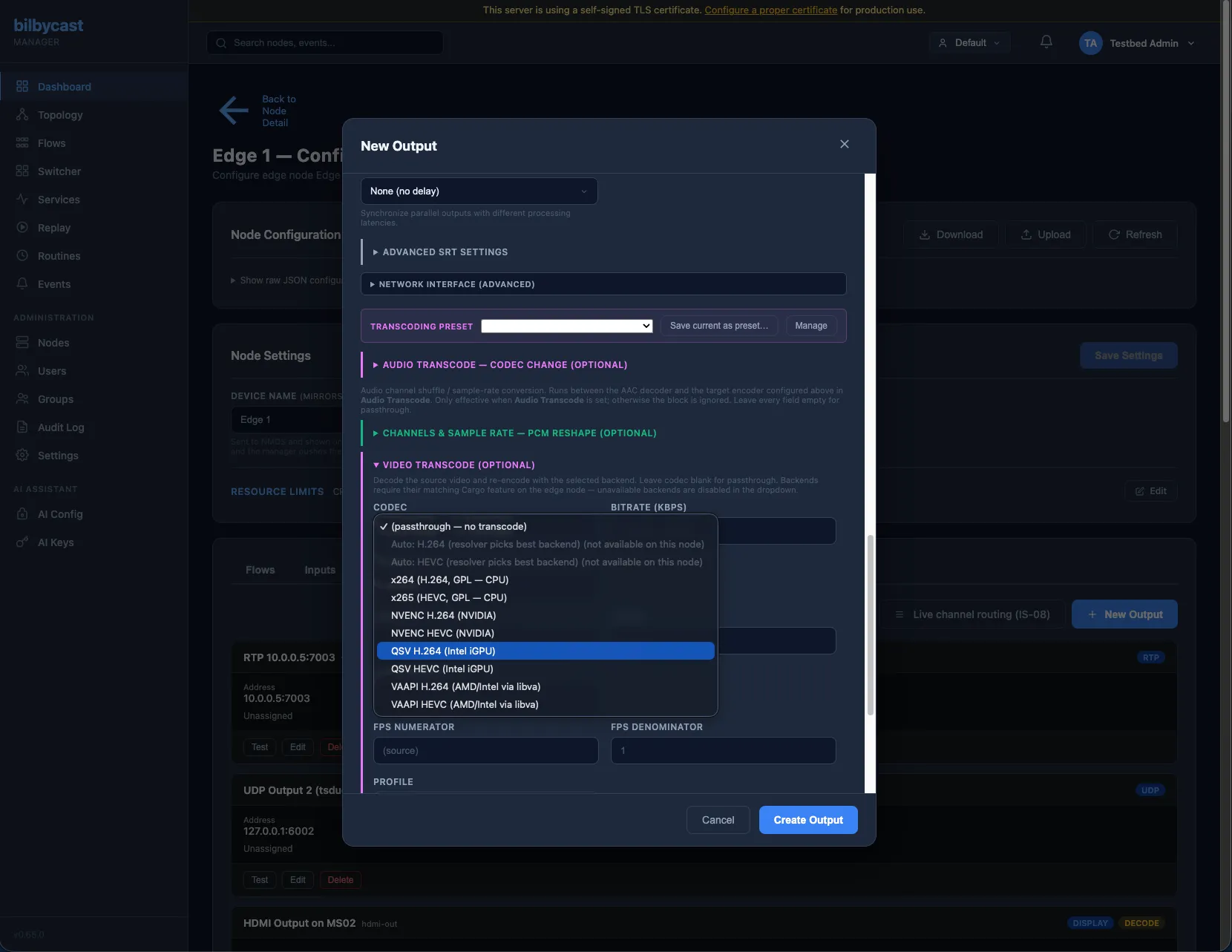
string | — | Required. x264, x265, h264_nvenc, hevc_nvenc, h264_qsv, hevc_qsv, h264_vaapi, hevc_vaapi, h264_rkmpp, hevc_rkmpp, or the resolver aliases h264_auto / hevc_auto / auto (bare auto means H.264). An explicit backend whose video-encoder-* Cargo feature this build lacks is refused at config load with the rebuild named; an *_auto alias is refused only when the build carries no video encoder at all. |
source_video_pid |
u16 | unset | Pin the source video elementary PID instead of taking the first video stream in the active program’s PMT (stream_type 0x01, 0x02, 0x1B, 0x24). Range 0x0010–0x1FFE. A pin that is absent from the live PMT falls back to first-match and logs video_source_pid_not_found — a log line only, no manager event, so a typo transcodes the wrong stream quietly. |
width / height |
u32 | source raster | 64–7680 / 64–4320, both even. Scaling is Lanczos via libswscale and is honoured on every re-encode path. |
fps_num / fps_den |
u32 | measured, else 30/1 |
Set together or not at all; effective rate 0.5–240. Never a resampler — every source frame is encoded, so this declares the rate. On TS paths the rate is measured from PES DTS deltas and locked before the encoder opens, but only when the field is unset; pinning suppresses the measurement. RTMP, WebRTC and CMAF have no measurement and fall back to 30/1, so pin them. |
bitrate_kbps |
u32 | 8000 |
100–100000. |
gop_size |
u32 | 2 × fps |
1–600. A CMAF output uses 60 when unset, whatever the frame rate, because its segmenter wants a steady GoP. |
preset |
string | medium |
ultrafast, superfast, veryfast, faster, fast, medium, slow, slower, veryslow. |
profile |
string | encoder’s choice | baseline, main, high, high10, high422, high444 (H.264); main10, main422-10, main422-10-intra (HEVC). Validated against chroma + bit_depth — main422-10 without chroma: "yuv422p" and bit_depth: 10 is refused. |
chroma |
string | yuv420p |
yuv420p, yuv422p, yuv444p. Combinations the named backend cannot carry are refused at config load, not at first frame. |
bit_depth |
u8 | 8 |
8 or 10. |
rate_control |
string | cbr |
vbr, cbr, crf, abr. CBR is the default — broadcast contribution wants a flat wire rate, and VBR complicates downstream mux ingest. |
crf |
u8 | 23 |
0–51, lower is better; broadcast typical 18–28. Only consulted with rate_control: "crf", where it replaces bitrate_kbps. Mapped to cq on NVENC. |
max_bitrate_kbps |
u32 | unset | VBV ceiling for vbr / abr. 100–100000 and must be ≥ bitrate_kbps. Meaningless in cbr (the ceiling is bitrate_kbps) and in crf. |
bframes |
u8 | 0 |
0–16. Pinned to 0 on RTMP — FLV tags carry no composition-time offset, so a reordering encoder drives DTS backwards and most ingests drop the publisher. The pin logs rtmp_bframes_unsupported. |
refs |
u8 | encoder’s choice | 1–16. |
level |
string | encoder’s choice | e.g. "4.0", "5.1". Digits and dots, at most 8 characters. |
tune |
string | zerolatency on x264 / x265, unset on every hardware backend |
The vocabularies are disjoint: x264 / x265 take zerolatency, film, animation, grain, stillimage, fastdecode, psnr, ssim; NVENC takes hq, ll, ull, lossless; QSV, VAAPI and RKMPP expose no tune at all. Validation is permissive over the union because an *_auto output does not know its backend until flow start; a tune the resolved backend cannot accept is dropped then, logging encoder_tune_not_supported. That drop matters — handing NVENC zerolatency fails avcodec_open2 with EINVAL. |
color_primaries |
string | unset | bt709, bt2020, smpte170m, smpte240m, bt470m, bt470bg. |
color_transfer |
string | unset | bt709, smpte170m, smpte2084 (alias pq), arib-std-b67 (alias hlg), bt2020-10, bt2020-12. |
color_matrix |
string | unset | bt709, bt2020nc, bt2020c, smpte170m, smpte240m. |
color_range |
string | unset | tv (aliases limited, mpeg) or pc (aliases full, jpeg). |
hw_decode |
string | auto |
Which backend decodes the source before re-encode: auto, cpu, nvdec, qsv, vaapi, rkmpp. See Hardware decode of the source. |
How h264_auto and hevc_auto resolve
Section titled “How h264_auto and hevc_auto resolve”*_auto is the right answer for most deployments. At flow start the edge asks the startup hardware probe what this host can actually open for the requested (family, chroma, bit_depth) and builds a chain, hardware first and CPU last:
| Family + chroma + bit depth | Chain (head first) |
|---|---|
| H.264, 4:2:0, 8-bit | h264_rkmpp ≻ h264_nvenc ≻ h264_qsv ≻ h264_vaapi ≻ x264 |
| H.264, anything else | x264 — no hardware H.264 encoder does 4:2:2, 10-bit or 4:4:4 |
| HEVC, 4:2:0, 8-bit | hevc_rkmpp ≻ hevc_nvenc ≻ hevc_qsv ≻ hevc_vaapi ≻ x265 |
| HEVC, 4:2:0, 10-bit | hevc_nvenc ≻ hevc_vaapi ≻ hevc_qsv ≻ x265 |
| HEVC, 4:2:2 (8 or 10-bit) | hevc_vaapi (Intel iHD) ≻ x265 — NVENC and QSV are skipped rather than tried, because they reject 4:2:2 at avcodec_open2 |
| HEVC, 4:4:4 | x265 |
Candidates the host cannot do are filtered out before the chain is handed over, so the head is what the probe says will work. h264_rkmpp / hevc_rkmpp only ever compile into the aarch64-linux-rockchip artefact, where none of VAAPI / NVENC / QSV can resolve — that is why they lead.
The chain is a fall-through, not a prediction. A backend that probed cleanly at startup can still fail avcodec_open2 later — the GPU is out of MFX sessions, a driver was updated under the running process, another flow took the last encode session. When that happens the pipeline logs the failure at info and opens the next candidate; landing anywhere but the head is logged at warn as a demote. Only when every candidate refuses does the encode fail.
Every backend in a chain is in the same codec family, which is what lets the PMT stream_type be settled from the head before any encoder opens.
An explicit backend name is a one-element chain: you asked for that encoder, so a silent substitution would be the wrong favour. If it cannot open, the flow reports it.
The chain is built on the TS re-encode path (SRT / UDP / RTP / RIST outputs and the ingress re-encode that feeds them), on RTMP, and on the multiviewer’s canvas encoder. Three paths do not take it — they resolve one backend and open it with no fall-through:
- WebRTC resolves a single backend and additionally caps the result at H.264 — a resolver that came back with HEVC is refused with a Critical event, because browsers cannot decode it.
- CMAF resolves nothing at all: its re-encoder takes explicit backend names only, and
h264_auto/hevc_auto/autoon acmafoutput are refused at config load with the reason named. Pick the backend by hand there. - Baseband ingest —
st2110_20,st2110_23,mxl_videoandsdi, the four inputs wherevideo_encodeis required — shares one resolver call and opens its head only. It is also the one place an explicit backend is substituted: a named hardware encoder the host cannot carry at the requested chroma / bit depth is demoted to the same family’s software encoder (x264orx265), loggingencoder_chroma_not_supportedrather than failing the input.
Hardware decode of the source
Section titled “Hardware decode of the source”A transcode is a decode and an encode, and hw_decode chooses the decode half independently of the encoder. auto (the default) walks VAAPI ≻ NVDEC ≻ QSV ≻ RKMPP ≻ CPU against the compiled-in video-decoder-* features and the probe; cpu forces software libavcodec, which is how you keep the host’s hardware decode sessions free for other flows.
A forced backend the build or the host cannot satisfy does not fail the flow: the edge logs hw_decode preference … unavailable …; falling back to CPU and runs on CPU, and so does an edge whose startup probe never ran. That is deliberately unlike the display output, which raises an event for the same situation — so on a transcode, check the log rather than the Events page when you expect hardware decode and the CPU is busier than you budgeted for.
These are the same decoders the local-display path uses, so an edge built for HDMI playout gets hardware transcode decode for free.
audio_encode and its encoders
Section titled “audio_encode and its encoders”Everything encodes in-process on a default build (fdk-aac and media-codecs are both on, and all three release artefacts carry them):
| Codec | Encoder | Max channels | Default bitrate | Notes |
|---|---|---|---|---|
aac_lc |
Fraunhofer FDK AAC | 8 | 128 kbps | The general-purpose choice; 5.1 and 7.1 both encode. |
he_aac_v1 |
Fraunhofer FDK AAC | 2 | 64 kbps | SBR. |
he_aac_v2 |
Fraunhofer FDK AAC | 2 (exactly) | 32 kbps | Parametric Stereo — mono is refused at config load, not at flow start. |
opus |
libopus via libavcodec | 2 | 96 kbps | WebRTC outputs only. Always 48 kHz on the wire whatever sample_rate says. |
mp2 |
libavcodec | 2 | 192 kbps | DVB / SD broadcast. |
ac3 |
libavcodec | 6 | 192 kbps | ATSC; 5.1 encodes. |
s302m |
none — a lossless PCM wrap | 2, 4, 6 or 8 | n/a | PCM and AES3 inputs only. bitrate_kbps is refused rather than ignored, and sample_rate must be exactly 48000. |
Only a build compiled without fdk-aac / media-codecs falls back to an ffmpeg subprocess for the affected codecs — on a release binary the encoder never leaves the process, so there is no restart budget, no pipe, and no ffmpeg to install.
bitrate_kbps is 16–512. sample_rate, when set, must be one of 8000, 16000, 22050, 24000, 32000, 44100, 48000; unset follows the source. channels unset follows the source, and the ceiling above is enforced per codec at config load.
Opus is accepted on a webrtc output and nowhere else. MPEG-TS has no standard Opus mapping, so SRT, UDP, RTP, RIST and HLS refuse it; FLV carries the AAC family only, so RTMP refuses it; and the CMAF audio sample entry is MPEG-4 AAC, so CMAF refuses it too. All of that is a config-load error, not a surprise at flow start.
The full audio_encode and transcode reference — source_audio_pid pinning, silent_fallback, the four opus_* knobs, channel-map presets, SRC quality and dither — lives on Audio Gateway.
Combinations that are refused
Section titled “Combinations that are refused”Validation rejects these at config load and on every update_config, so nothing reaches a running flow:
| Combination | Why |
|---|---|
audio_encode or video_encode + transport_mode: "audio_302m" |
The 302M path owns the TS stream already. |
audio_encode or video_encode + SMPTE 2022-7 redundancy (SRT / RTP / RIST) |
The two legs would carry independently encoded bitstreams; a receiver cannot merge them. |
audio_encode or video_encode + SMPTE 2022-1 fec_encode (RTP) |
Re-muxing breaks the RTP sequence-number space the FEC matrix is computed over. |
audio_encode or video_encode + SRT packet_filter FEC |
Same reason. |
transcode without audio_encode on a compressed output |
transcode is a stage inside the encode pipeline; alone it would be a silent no-op. |
audio_encode + video_only: true (WebRTC) |
An audio MID has to be negotiated in the SDP. |
Multi-program pid_overrides + either block |
The in-place transcoders handle one program at a time. Split into one output per program, each with its own program_number filter. |
An HEVC codec on a webrtc output, including hevc_auto |
Browsers do not decode HEVC, so a rebuild would not help either. |
h264_auto / hevc_auto / auto on a cmaf output |
The CMAF re-encoder resolves no alias. |
A transcoded output is also outside the scope of cross-node egress alignment: epoch_lock requires non-transcoded forwarding, so alignment and PCR/PTS regeneration are mutually exclusive.
Confirming what actually ran
Section titled “Confirming what actually ran”The resolved backend reaches the stats API once the encoder has opened — it is the backend that opened, not the one that was requested, so a fall-through demote is visible:
curl -s http://localhost:8080/api/v1/stats/<flow_id> \ -H "Authorization: Bearer $TOKEN" | \ jq '.outputs[] | {output_id, video_encode_stats}'video_encode_stats.encoder_backend reads x264, x265, nvenc, qsv, vaapi or rkmpp; alongside it, input_codec / output_codec, the target raster and rate, dropped_frames, last_latency_us, and source_pid / source_stream_type (which video stream the replacer locked onto). The same block appears under .input for an ingress re-encode. Outputs that pass video through carry no video_encode_stats at all.
In the log, an Auto resolution prints the whole chain at flow start:
video_encode auto-resolved 'hevc_auto' → chain ["hevc_vaapi", "x265"] (head fires first; later entries are fall-through)Encode cost is charged against the node’s resource budget — hardware backends start at 100 units and software at 500, scaled by pixel rate, chroma and bit depth. See Resources & Capacity for the formula and the per-family hardware session caps.
Known limitations
Section titled “Known limitations”- Frame rate is declared, never converted. No path resamples; a pinned rate that disagrees with the source mistunes rate control, the default GOP and the SPS VUI, and logs
video_encode_fps_mismatchonce per encoder run. Output PES PTS still carry the source clock, so this is not a proportional lipsync drift. - HLS has no
video_encode. Usecmaffor segmented egress with a re-encode. - No keyframe alignment to the source. The encoder emits IDRs on its own GOP cadence — except on a multi-input flow, where switching to an input that has ingress
video_encodeforces an IDR on the first frame after the take, so switch latency at the receiver stays at one to two frames instead of up to a GOP. - B-frames are off by default everywhere and unavailable on RTMP.
- Scaling covers 4:2:0 and 4:2:2 at 8 and 10-bit. A 4:4:4 target has no scaler destination format, so a resize request logs a warning and the encoder crops instead of scaling.
- ST 2110-22 (JPEG XS) transcoding is deferred pending a JPEG XS wrapper crate.
See also
Section titled “See also”- Codec Matrix — per-backend chroma / bit-depth support, what
*_autoactivates on each host class, and the verification commands. - Audio Gateway — the full
audio_encode/transcodereference, including PCM and SMPTE 302M paths. - Configuration — where these blocks sit in
config.json, field by field, per input and output type. - Resources & Capacity — encode cost units and hardware session limits.
- Master Clock & A/V Sync — how a re-encode interacts with PCR regeneration and egress alignment.